Best Compact Fish Finder for Kayaks and Small Boats

A ranked shortlist of five compact fish finders, from the 8 oz Garmin Striker 4 to a wireless castable sonar, with the deciding specs and the trade-offs named.

By Ash MoralesUpdated 15 min read
On this page
- Best compact fish finder at a glance
- The deciding spec is not screen size
- How I cut the shortlist to five
- 1. Garmin Striker 4 — Best overall
- 2. Garmin Striker Vivid 4cv — Best premium
- 3. Lowrance Eagle 4X — Best for beginners
- 4. Venterior Portable Rechargeable Fishfinder — Runner-up
- 5. Yoocylii Handheld Fishfinder — Best budget pick
- Screen size, weight and what actually fits a kayak
- CHIRP, wireless sonar or handheld: which reads the water?
- What does a compact fish finder not do well?
- Mounting, power and the small stuff nobody mentions
- The verdict
- FAQ
The best compact fish finder is the Garmin Striker 4, a 3.5-inch CHIRP unit that weighs 8 oz and still carries GPS waypoints in a body measuring 5.9 x 3.6 x 1.6 in. If you want a larger 4-inch colour screen with Quickdraw Contours mapping, the Garmin Striker Vivid 4cv is the better buy at 0.7 lb. Five picks follow, ordered by how well the published specifications match small-boat and kayak use.
Best compact fish finder at a glance
| Pick | Screen | Weight | Price |
|---|---|---|---|
Best overall Garmin Striker 4 |
3.5 in | 8 oz | Check Price |
Best premium Garmin Striker Vivid 4cv |
4 in | 0.7 lb | Check Price |
Best for beginners Lowrance Eagle 4X |
4 in portrait | 2.76 lb | Check Price |
Runner-up Venterior Wireless Sonar |
handheld | 0.94 lb | Check Price |
Best budget pick Yoocylii Handheld Fishfinder |
handheld | not listed | Check Price |



The deciding spec is not screen size
Most compact fish finder guides compare screen size. That is not what decides it. Sonar type is. A 3.5-inch CHIRP head separates two bait balls stacked over the same rock; a 4-inch handheld with a 200 kHz single-frequency probe shows one blob and calls it a fish. Two of the five picks here run Garmin CHIRP. The Lowrance Eagle 4X pairs its 4-inch portrait screen with a 200 kHz Bullet Skimmer, and the two handheld units use fixed 200 kHz sonar without CHIRP.
Screen size matters second. Weight and mounting footprint matter third. If you are picking between two units at the same sonar tier, then the 4 in display beats the 3.5 in every time. Across tiers, sonar wins.
The word "compact" is doing real work here. Amazon's category returned two handheld sonars alongside three mounted units, and only one of the handhelds publishes weight and dimensions. Treat the size question as your own to judge from the figures below, not as a filter Amazon already applied.
How I cut the shortlist to five
I started from the category listings and cut on three criteria, in this order.
- Sonar clarity. Anything without CHIRP or a stated frequency was ranked below anything that publishes one.
- Mount or handheld classification. Mixed together, but each pick tagged with the use case its specifications actually match.
- Published warranty and dimensions. A listing with neither figure lost points against one that published both.
Three reasons picks were cut and did not make the five: no published transducer frequency, weight above 3 lb (already outside "compact" for a kayak gunwale), and duplicate Garmin Striker variants that only differed by screen size.
What survived is a mix by design. Two Garmin units carry CHIRP and cover the mounted-console case at 3.5 in and 4 in. The Lowrance Eagle 4X sits between them on price with a portrait screen and auto-tuning sonar. Two handhelds, one wireless and castable, one on a neck strap, cover shore and ice fishing where a transducer cable is a nuisance. Every pick's Amazon listing publishes at least a frequency or a CHIRP claim, so the sonar comparison is grounded in what the manufacturer states rather than what I want to be true.
1. Garmin Striker 4 — Best overall
The Striker 4 is the lightest CHIRP-capable fish finder in this set at 8 oz, and it still carries GPS waypoints on a 3.5-inch screen.
Best for: kayak and small-boat anglers who want CHIRP sonar and GPS waypoints in the smallest usable package. Skip it if: you fish from shore or want a castable, cable-free unit.
The Striker 4's case measures 5.9 x 3.6 x 1.6 in, which is the smallest console footprint of the mounted units here. Garmin says the CHIRP sonar sweeps a range of frequencies rather than pinging one, which the listing claims produces crisper fish arches and better target separation than a single-frequency transducer. It also claims Clear Vu scanning sonar and a maximum depth of 1,600 ft in freshwater and 750 ft in saltwater. The waypoint map lets you mark brush piles, stumps and docks, and Garmin lists a built-in flasher view for ice fishing or vertical jigging.
The trade-off is age and screen size. This is a 2015 model and the display is 3.5 in versus 4 in on the two newer picks. It also ships with a 1-year limited warranty, half the duration of the Venterior and the Striker Vivid 4cv. On a kayak with limited mount space, that is the price of the smallest CHIRP head Garmin makes.
Pros:
- 8 oz head, the lightest mounted unit in this set
- CHIRP sonar and Clear Vu scanning on both frequencies
- GPS waypoints with a route and speed readout
- Built-in flasher view for ice fishing
- IPX7 water rating stated on the listing
Cons:
- 3.5 in screen, smaller than the two 4 in picks
- 1-year limited warranty, shortest of the three units that publish one
- 2015 model, oldest in the set
- No stated Quickdraw mapping
2. Garmin Striker Vivid 4cv — Best premium
The Vivid 4cv is the newest pick in the set and pairs CHIRP with Quickdraw Contours mapping on a 4-inch colour screen.

Best for: anglers upgrading from a plain 2D unit who want a larger colour screen and Quickdraw mapping. Skip it if: your console cannot spare a 4-inch mount or you already own a 3.5-inch head.
Released in 2020, the Vivid 4cv is the most recent unit here and the most expensive. Garmin lists a 4 in display with what the brand calls vivid scanning sonar colour palettes, aimed at making fish and structure easier to separate at a glance. The included GT20 transducer supports Garmin CHIRP traditional sonar and CHIRP ClearVü scanning sonar, and the unit has high-sensitivity GPS with waypoints, routes and boat speed. Quickdraw Contours lets the unit build its own 1-foot contour map of the water you fish, according to Garmin.
At 0.7 lb, it is heavier than the Striker 4's 8 oz but lighter than the Lowrance Eagle 4X's 2.76 lb. The warranty is 2 years, twice the Striker 4's, and a tilt/swivel bailmount bracket is included. The obvious trade-off is the price position: it is the most expensive pick here for what is functionally the Striker 4 with a bigger screen, colour palettes and a 2-year warranty. If those three additions matter to you, the extra outlay is small. If they do not, the older model does the same sonar job.
Pros:
- 4 in colour display with multiple palettes
- CHIRP traditional plus CHIRP ClearVü sonar
- Quickdraw Contours mapping built in
- 2-year limited warranty, joint longest here
- Tilt/swivel bailmount bracket included
Cons:
- Most expensive pick in the set
- 0.7 lb head, heavier than the Striker 4
- Larger 6 x 8 x 11.5 in packaged footprint on a small console
- No stated depth ceiling on the listing
3. Lowrance Eagle 4X — Best for beginners
The Eagle 4X is the only portrait-oriented pick, and its auto-tuning sonar removes most of the setup a new user has to think about.

Best for: first-time buyers on a small boat or kayak who want a portrait screen and auto-tuning sonar. Skip it if: you need GPS waypoints or a lighter head unit.
Lowrance lists a 4 in IPS portrait screen the brand says stays readable in bright sunlight, from wide viewing angles, and through polarised glasses. The Auto-Tuning Sonar feature is the interesting part for a beginner: the listing says the unit picks optimal settings on its own so you can focus on fishing rather than gain, range and clutter menus. The included 200 kHz Bullet Skimmer delivers what Lowrance calls a 44-degree beam, tuned for kayaks and small boats, and a twist-lock connector for fast install and removal.
Two things to weigh. At 2.76 lb, this is the heaviest head unit in this set by a wide margin, more than three times the Vivid 4cv. And unlike the two Garmins, the Eagle 4X does not advertise GPS or waypoints. If you plan to mark and return to fishing spots, that is a real gap. If you plan to read depth and structure, drop a line and go home, the auto-tuning and the portrait screen are a sensible fit. Warranty is 1 year on the listing.
Pros:
- Auto-Tuning Sonar, the only pick with it
- 4 in IPS portrait screen, unique layout in this set
- 44-degree beam Bullet Skimmer for small boats
- Twist-lock connector for quick removal
- Fish icons with depth and zoom
Cons:
- 2.76 lb, heaviest head in the set
- No GPS or waypoints stated on the listing
- 1-year warranty, shorter than the two 2-year units
- No stated CHIRP support
4. Venterior Portable Rechargeable Fishfinder — Runner-up
The Venterior is a castable wireless sonar with a 2-year warranty, and it is the only pick here that works untethered from a boat.

Best for: shore, ice and bank anglers who need a castable wireless sensor. Skip it if: you want a mounted transducer with CHIRP detail.
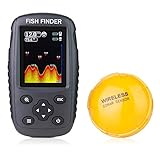
The Venterior weighs 0.94 lb and measures 2.75 x 2.75 x 2.75 in, and Venterior says the wireless sonar probe connects to the handheld unit at up to 262 ft. The listing states that the unit displays water depth, temperature, fish size in three bands, fish depth and bottom contour, with two selectable background colours for daylight and night reading. Venterior positions it for lakes, rivers, sea, kayak fishing, bank fishing and ice fishing. Warranty is 2 years, joint longest here.
Two honest limits. The listing does not state a CHIRP sonar, so structure detail will not match the Garmins even when the water is quiet. And the "fish size" reading is exactly that: an icon in one of three size bands, not a real length estimate. What you gain in exchange is a sonar you can cast from a dock or a shore, drop into an ice hole, or run alongside a kayak without wiring a transducer. Among the set, this is the pick most likely to earn its place as a second unit rather than a first one.
Pros:
- Castable wireless sensor, up to 262 ft range claim
- 2-year warranty, joint longest in the set
- Reads depth, temperature and bottom contour
- Two-colour display for day and night
- Works for shore, kayak and ice fishing
Cons:
- No CHIRP or scanning sonar stated
- Fish size shown as three icon bands
- 0.94 lb handheld, heavier than a phone-sized unit
- No GPS or waypoints
5. Yoocylii Handheld Fishfinder — Best budget pick
The Yoocylii is the cheapest pick here and the lightest to carry, with a neck strap for kayak use.

Best for: occasional anglers who want a neck-strap sonar for depth and rough fish location. Skip it if: you need a warranty figure or dimensions published on the listing.
Yoocylii keeps the listing short. The unit shows water depth, an approximate fish location and size in three bands, weed height, and whether the bottom is sand or rock. Sonar frequency is stated at 200 kHz with a 45-degree beam angle under the transducer. The listing points out a neck strap that lets you wear it on a kayak, and describes use as tossing the transducer into the water and turning on the display.
The reason this pick sits at number 5 is not the sonar. It is the missing data. The listing does not publish weight, dimensions, warranty duration or a model number, and the warranty text on the page references a different brand's cover. A shopper who cares about after-sales support should treat that gap seriously. For the price position, though, the Yoocylii covers the basic job: depth reading and rough fish location, portable enough to hang round your neck while you paddle. That is a genuine use case, and this pick fills it at the lowest outlay in the set.
Pros:
- Cheapest pick in the set
- Neck strap for hands-free kayak use
- Stated 200 kHz sonar with 45-degree beam
- Reads depth, weed and bottom type
- Simple two-step operation
Cons:
- No published weight, dimensions or model number
- Warranty text on the listing references a different brand
- No CHIRP, GPS or bottom contour
- Slowest seller of the five here
Screen size, weight and what actually fits a kayak
A gunwale mount on a 10 or 12 ft kayak has less flat real estate than most anglers remember. Three specifications tell you whether a compact fish finder will sit there without fouling a paddle stroke.
- Head weight. Under 1 lb is fine on a RAM ball or a track mount. The Garmin Striker 4 at 8 oz and the Vivid 4cv at 0.7 lb both clear it. The Lowrance Eagle 4X at 2.76 lb wants a stiffer arm.
- Depth of the head from the mount face. The Striker 4's 1.6 in depth is the shallowest here. A deeper case catches wind and pushes the mount around.
- Screen orientation. Portrait screens like the Eagle 4X's show more of the water column at once. Landscape screens like the Strikers' show more sonar history along the horizontal axis, which is what most anglers actually read.
For a small tinny or a jon boat, weight matters less and mounting depth matters less. Screen brightness and viewing angle matter more, because you will read it from a standing position. That flips the balance toward the Eagle 4X and the Vivid 4cv, both 4 in units.
CHIRP, wireless sonar or handheld: which reads the water?
Three sonar types split the set. Each has a real strength and a real limit.
CHIRP sonar, on the two Garmins, sweeps a range of frequencies rather than one. Garmin says this separates two fish sitting close together into two arches instead of one blob. It also handles deeper water better: the Striker 4 lists 1,600 ft in freshwater. If your water is more than 40 or 50 ft deep, or if you fish structure, CHIRP is worth the price step.
Fixed-frequency 200 kHz sonar, on the Lowrance Eagle 4X and the two handhelds, is the traditional single-frequency approach. It reads depth and bottom cleanly and shows fish arches in shallow water. It struggles below about 200 ft and it does not separate close targets the way CHIRP does. For most kayak and small-boat fishing under 60 ft of water, that is fine.
Wireless castable sonar, on the Venterior, is a different animal. You cast the sensor on a line and the transducer sends data back to the handheld. The sensor's frequency is not published here as a CHIRP unit, so treat the data as depth, temperature and rough fish presence rather than fine structure.
What does a compact fish finder not do well?
Three things, and it is worth being honest about them before you buy.
First, deep water. Nothing in this set is a downrigger tool for 300 ft trolling. The one published freshwater ceiling here is the Striker 4's 1,600 ft, and that is the manufacturer's claim under ideal conditions on a small transducer.
Second, saltwater structure. The Striker 4 lists 750 ft in saltwater, and the other units do not publish a saltwater figure at all. In brackish or inshore water, a compact unit reads depth and shallow structure fine. Offshore, you want something bigger.
Third, side imaging. None of these five publish side-imaging sonar. Down-imaging, yes, on the two Garmins under Clear Vu and ClearVü. Side-scanning, no. If you fish flats and need to see 50 ft either side of the boat, this is the wrong category.
Mounting, power and the small stuff nobody mentions
Two practical points that the listings bury.
The mounted units, all three of them, need 12V power. On a kayak that means a small sealed lead-acid or lithium battery in a dry bag or a hatch, wired to the head. The Striker 4's low draw suits a 7Ah pack for a full day. The Vivid 4cv and the Eagle 4X are similar. Nothing in the set publishes a stated current draw, so plan a battery on the larger side of your estimate for the first trip.
The two handhelds run on internal batteries. The Venterior is described as rechargeable. The Yoocylii listing does not say. On a full-day trip, carry a small power bank if the unit charges over USB, and check before you leave the ramp.
Transducer mounting on the three console units is either transom, trolling motor, or a shoot-through-hull glue-in on a rigid boat. On a kayak, most anglers use a scupper-mount or a Lexan-arm setup off the side. The Eagle 4X's twist-lock connector is the one feature here that meaningfully speeds up pulling the head off between trips, and that matters more than it sounds if you paddle three times a week.
The verdict
The Garmin Striker 4 wins for two clear reasons. It is the smallest CHIRP-capable fish finder in this set, at 8 oz and 5.9 x 3.6 x 1.6 in, and it still carries GPS waypoints for marking brush piles and docks. On a kayak gunwale or a jon boat console, nothing else here fits with less compromise on sonar quality.
The runner-up depends on the water you fish. If you want the same sonar with a larger 4 in colour screen, Quickdraw Contours mapping and a 2-year warranty, the Garmin Striker Vivid 4cv is the exact upgrade for the money. If you are new to sonar and want the unit to tune itself, the Lowrance Eagle 4X and its Auto-Tuning Sonar do that job on a portrait 4 in IPS screen.
The two handhelds serve a genuinely different case: shore, bank and ice fishing, or a second unit you throw in the kayak hatch. The Venterior is the pick there, because it publishes a 2-year warranty and full dimensions. The Yoocylii covers the same ground for less if the missing warranty and weight figures do not bother you.
FAQ
Is a compact fish finder worth it for a kayak?
A compact fish finder is worth it for a kayak if you fish water deeper than about 8 ft or over structure you cannot see. Under those conditions, a 3.5 or 4 in screen shows depth, bottom type and fish arches while you paddle. In clear, shallow water where you can spot fish visually, it earns its place less obviously.
What is the difference between CHIRP and 200 kHz sonar?
CHIRP sonar sweeps a range of frequencies on every ping, which Garmin says produces crisper fish arches and better target separation than a single-frequency 200 kHz transducer. Fixed 200 kHz sonar, used on the Lowrance Eagle 4X and both handhelds here, still reads depth and bottom cleanly but shows two close fish as one blob rather than two arches.
How does the Garmin Striker 4 compare to the Striker Vivid 4cv?
The Garmin Striker 4 uses a 3.5 in screen, weighs 8 oz and ships with a 1-year warranty. The Garmin Striker Vivid 4cv steps up to a 4 in colour screen, 0.7 lb, a 2-year warranty and Quickdraw Contours mapping. Both run CHIRP with ClearVü scanning. If your console has room for the larger head, the Vivid 4cv is the upgrade.
Do I need GPS on a compact fish finder?
You need GPS on a compact fish finder if you want to mark fishing spots, brush piles or docks and return to them later. The Garmin Striker 4 and the Striker Vivid 4cv both publish GPS with waypoints and routes. The Lowrance Eagle 4X, the Venterior and the Yoocylii do not. For a small local lake, that gap matters less than on unfamiliar water.
Can a compact fish finder work for ice fishing?
A compact fish finder can work for ice fishing if it has a flasher view or a castable transducer. Garmin lists a built-in flasher on the Striker 4 for vertical jigging through the ice. The Venterior wireless sensor drops straight into an ice hole. The Lowrance Eagle 4X and the Yoocylii do not publish an ice fishing mode on the listing.
The right compact fish finder is the one that matches how you actually fish, not the one with the biggest published screen. If you paddle a kayak on lakes deeper than 15 ft and want to mark spots, start with the Garmin Striker 4 and add a small 12V battery. If you fish from the bank as often as the boat, add a Venterior wireless sensor alongside it. The Striker 4 earns the top spot because it is the only pick that combines CHIRP sonar, GPS waypoints and an 8 oz head, which is what "compact" actually means when the mount is a kayak gunwale rather than a console.