Best Radiator Coolant for Hot Weather: Zerex Wins

Five prediluted and concentrate coolants ranked for summer heat, with the deciding chemistry named upfront and the trade-offs made plain.

By Ash MoralesUpdated 15 min read
On this page
- Best radiator coolant for hot weather at a glance
- How I screened the shortlist
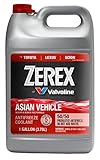
- 1. Zerex Asian Vehicle Red Silicate and Borate Free 50/50 — Best overall
- 2. Prestone MAX Orange 50/50 Antifreeze — Best warranty
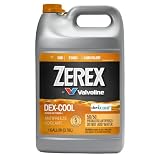
- 3. Valvoline Zerex Dex-Cool 50/50 — Best upgrade
- 4. Honda Genuine Extended Life Antifreeze/Coolant Type 2 — Best premium
- 5. Valvoline Zerex G48 Concentrate — Best minimal setup
- Why the label colour is the wrong place to start
- What actually protects a cooling system in summer heat?
- Prediluted or concentrate: which should you buy?
- How long does a gallon actually last on a top-up?
- What the listings do not tell you
- The verdict
- FAQ
The best radiator coolant for hot weather in this set is the Zerex Asian Vehicle Red 50/50, a silicate- and borate-free HOAT chemistry rated for a 5 year/150,000 mile service life in Toyota, Lexus, Hyundai, Kia and Mitsubishi systems. If your car takes a Dex-Cool orange instead, the Valvoline Zerex Dex-Cool 50/50 is the right pick, with a claimed summer boil ceiling of 265°F and a 5 year/150,000 mile guarantee against boil-overs.
Best radiator coolant for hot weather at a glance
| Pick | Chemistry | Service claim | Price |
|---|---|---|---|
Best overall Zerex Asian Vehicle Red 50/50 |
HOAT, silicate & borate free | 5 yr / 150,000 mi | Check Price |
Best warranty Prestone MAX Orange 50/50 |
CorGuard, orange | 15 yr / 350,000 mi warranty | Check Price |
Best upgrade Valvoline Zerex Dex-Cool 50/50 |
OAT Dex-Cool, orange | 5 yr / 150,000 mi guarantee 265°F boil claim |
Check Price |
Best premium Honda Genuine Type 2 Blue |
OEM Honda Type 2, blue | up to 5 yr / ~60,000 mi claim | Check Price |
Best minimal setup Valvoline Zerex G48 Concentrate |
G48 concentrate | Mix with distilled water | Check Price |



How I screened the shortlist
I started with the antifreeze and coolant category and set three cuts before looking at anything else. First, the fluid had to be usable in a passenger car cooling system, so straps of workshop bulk pails and heavy-duty diesel-only blends were out. Second, the listing had to publish a chemistry family the reader can check against an owner's manual: HOAT, OAT/Dex-Cool, G48 or an OEM factory type. Third, either a prediluted 50/50 or a plain concentrate, with the ratio stated on the jug.
That left five products spanning four chemistries and both entry and premium price positions. Two are Valvoline Zerex, one is the Asian-vehicle red HOAT and the other is Dex-Cool orange. One is the OEM Honda Type 2 blue. One is Prestone MAX Orange with the longest published warranty in this set. The last is a G48 concentrate for anyone who prefers to control the water side themselves.
The weight and dimension figures came along for free and are useful: a 1 gallon jug of the prediluted Honda Type 2 is listed at 9.25 lb, close to a full gallon of water, while the Zerex Asian Red 50/50 is listed at 5 lb, which is a discrepancy worth checking against the shipping label if you order more than one.
1. Zerex Asian Vehicle Red Silicate and Borate Free 50/50 — Best overall
A factory-style HOAT red for Asian-make cooling systems, sold ready to pour and rated for a long summer service life.
Best for: Toyota, Lexus, Scion, Hyundai, Kia and Mitsubishi owners who want a factory-matched HOAT fluid. Skip it if: your owner's manual specifies Dex-Cool or a Honda Type 2 blue.
This is the pick that reads cleanest against a real owner's manual. Zerex names the OEM and industry specs on the label: JIS K 2234-1994, Hyundai/KIA MS 591-08, Mitsubishi ES-64217, Ford WSS-M97B55-A, ASTM 3306, ASTM D4985 and Federal Specification A-A-870A. That is a longer list of published approvals than any other jug in this set, and it maps directly onto the red HOAT fluids fitted at the factory in most Asian marques since the mid-2000s.
The chemistry matters for summer. Zerex describes it as a silicate-free, phosphate-bearing HOAT with a 5 year or 150,000 mile service claim. The formula is also borate free, which the brand says helps limit scale and deposits on hot metal surfaces. It is the cheapest of the five here and the one buyers pick most often in this set, which is a rare combination.
The trade-off is fit. If your car needs orange Dex-Cool or Honda blue, the red HOAT is not the correct fluid, however good the chemistry looks on paper.
Pros:
- HOAT chemistry with a published 5 yr / 150,000 mi service claim
- Named approvals for Toyota, Hyundai, Kia and Mitsubishi
- Silicate free and borate free per the listing
- Cheapest of the five picks
- The one buyers choose most often here
Cons:
- Wrong chemistry for Dex-Cool or Honda Type 2 systems
- Listed shipping weight of 5 lb is lower than the other 1 gallon jugs here
- Prediluted only, so you pay to ship water
2. Prestone MAX Orange 50/50 Antifreeze — Best warranty
Prestone's orange OAT with a 15 year / 350,000 mile warranty on the label, by far the longest coverage in this set.

Best for: drivers who want the longest published protection commitment in this set. Skip it if: your vehicle needs an OEM-matched Asian or Honda formula.
Prestone MAX is the second-cheapest jug here and carries the longest published warranty of the five: 15 Years or 350,000 Miles. That is triple the service claim on either Zerex product and it is the single strongest bit of paperwork any of these listings put in front of a buyer. Prestone credits its patented CorGuard corrosion package for the coverage.
For hot weather specifically, Prestone says the fluid provides "Extreme Temperature Protection from the worst of winter deep freezes and scorching summer heat." That is a marketing sentence rather than a boil-point figure, so treat it as an attributed claim, not a measured number. Prestone also notes the fluid contains a bitterant, which is a safety touch worth having in a garage with pets.
The gap between MAX and the Zerex Asian Red is that Prestone does not publish a list of named OEM approvals on this listing. If your owner's manual is prescriptive about JIS or Honda Type 2 or Dex-Cool, MAX's generic orange OAT is not a like-for-like match. It is a strong choice where the manual allows a universal orange OAT.
Pros:
- 15 yr / 350,000 mi published warranty
- CorGuard corrosion technology per the label
- Contains a bitterant for garage safety
- Second-cheapest pick in this set
Cons:
- No named OEM approvals on the listing
- Manufacturer's summer language is qualitative, not a boil-point figure
- Slowest seller of the five picks here
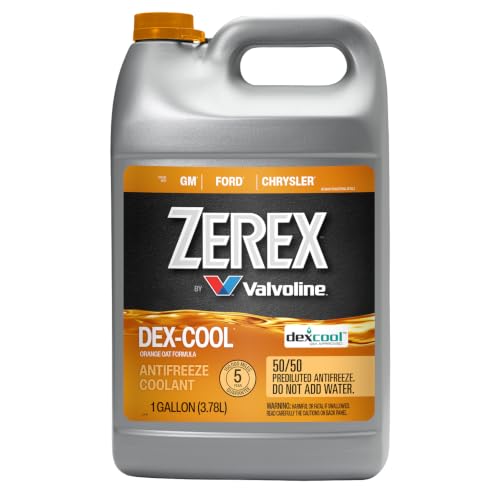
3. Valvoline Zerex Dex-Cool 50/50 — Best upgrade
A Dex-Cool orange OAT with the only published summer boil figure in this set: a 265°F ceiling claim from Valvoline.
Best for: GM and other Dex-Cool systems, with published summer boil numbers. Skip it if: your car calls for a HOAT or a silicated European formula.
This is the coolant to buy if your car takes Dex-Cool orange. Valvoline states a 5 year or 150,000 mile guarantee against engine failure from freeze-ups or boil-overs, and it is the only jug of the five whose listing prints both a freeze point and a boil point: -34°F and 265°F for the prediluted 50/50 mix. Those are the hot-weather numbers a shopper is actually looking for on this page, and no other pick provides them.
The additive package is described as organic acid technology, with corrosion protection called out for aluminum radiators, water pumps and heater cores. Valvoline also says the formula is safe for gaskets, hoses, plastics and paint, which matters when a top-off inevitably ends up on a fender. Shipping weight is listed at 9 lb per gallon, which is what you would expect for a real gallon of prediluted 50/50.
The obvious limitation is compatibility. Dex-Cool orange is not a universal fluid, however much the colour suggests it is. In a Toyota or a Honda it is the wrong pick.
Pros:
- Published boil claim of 265°F on the 50/50 mix
- 5 yr / 150,000 mi guarantee against boil-overs
- Named aluminum corrosion protection
- Second-most-bought of the five here
Cons:
- Wrong fluid for HOAT or European silicated systems
- Higher price position than either entry pick
- Prediluted only
4. Honda Genuine Extended Life Antifreeze/Coolant Type 2 — Best premium
The factory blue Type 2 fluid, prediluted 50/50 and sold as the exact replacement for Honda part number OL999-9011.

Best for: late-model Honda owners who want the factory blue Type 2. Skip it if: you want the longest warranty on paper.
Honda's own Type 2 blue is the most expensive pick here and the only one carrying an OEM factory-fill claim. Honda says it "replaces part number OL999-9011" and "matches factory fill for Honda systems requiring Type 2 coolant." For an owner who has been told by a dealer to use Honda blue only, that sentence is the whole reason to buy it.
For summer running, Honda lists "freeze protection and boil-over resistance for extreme temperature performance," without a boil figure. The service claim is up to 5 years or about 60,000 miles under normal conditions, which is the shortest mileage window in this set. Note the "under normal conditions" wording: severe-duty service is a shorter interval on any long-life coolant, and Honda is one of the few brands that says so plainly on the jug.
At 9.25 lb per gallon and 4 x 11.7 x 7.5 in, this is the heaviest and most compactly boxed pick, which matches a real gallon of prediluted fluid. The trade-off against the Prestone is the paperwork: you are paying more for a matched OEM formula and accepting a shorter published mileage claim.
Pros:
- OEM Honda factory-fill match to OL999-9011
- Prediluted 50/50 ready to pour
- 9.25 lb listed weight is consistent with a full gallon
- Named corrosion protection for metal and non-metal parts
Cons:
- Highest price position of the five
- Shortest mileage claim in the set at ~60,000 miles
- Only two sellers list it
5. Valvoline Zerex G48 Concentrate — Best minimal setup
A G48 concentrate for owners who prefer to mix their own 50/50 with distilled water, sitting in the premium price position.

Best for: shops and DIYers who prefer to mix concentrate with their own distilled water. Skip it if: you want to pour straight from the jug.
This is the odd one out in a good way. G48 is the silicated hybrid chemistry originally specified by BMW, Volvo, Mini and other European marques, and Valvoline sells it here as a plain concentrate. The listing gives the size as 1 gallon, weight as 9.31 lb and dimensions as 11.8 x 7.67 x 3.93 in. Model number 861583, released in 2018 per the listing.
The upside is control. A concentrate lets you dial the mix to your climate rather than accepting the prediluted 50/50 that ships with a factory jug. In a hot climate you may want to stay at 50/50 for the boil protection glycol provides, but you can also do the mixing with a jug of distilled water rather than paying to ship water across the country.
The downside is that Valvoline's listing for this product is thin. The features section reads only "Professional" and "High performance," which is not much to go on. There is no published warranty, no named OEM approvals, and no boil-point figure. If you are a G48 buyer you already know why you want it. If you are not, one of the ready-mixed picks above is the safer choice.
Pros:
- Concentrate lets you control the water side
- G48 chemistry as sold by a mainstream brand
- 9.31 lb listed weight consistent with a real gallon
- Model and release year printed on the listing
Cons:
- Very thin feature description on the listing
- No published warranty or mileage claim
- Premium price position with the least paperwork of the five
- Requires distilled water and mixing before use
Why the label colour is the wrong place to start
The single most common mistake in this category is buying by colour. Two orange jugs on this page use different chemistries: the Valvoline Zerex Dex-Cool is an OAT and the Prestone MAX Orange is a CorGuard OAT with a different additive package. A Honda Type 2 blue is not the same as a European blue G11. A Toyota red HOAT is not the same as a European red G12++.
Colour is a marketing choice by the fluid maker, not a chemistry standard. Two coolants of the same colour can be incompatible in the same cooling system, and mixing incompatible chemistries can drop additive packages out of suspension and clog a heater core.
Start with the owner's manual. It will name a chemistry family, sometimes a colour, sometimes an OEM part number. Match that first, then choose between brands.
What actually protects a cooling system in summer heat?
The specification that decides hot-weather performance is not the freeze point but the boil-over margin. Glycol raises the boiling point of the mix, and a pressurised cap on the radiator raises it further. A 50/50 prediluted mix like the Valvoline Zerex Dex-Cool is claimed to boil at 265°F under a 15 psi cap, well above coolant temperatures you would see on a hot highway pull.
Three things drive summer failure:
- A weak cap. A cap that will not hold pressure lowers the boiling point regardless of which fluid is in the jug.
- A depleted additive package. Corrosion inhibitors are consumed over years, which is why every jug in this set publishes a service interval.
- A wrong-chemistry top-off. Mixing a HOAT into an OAT system can gel the additive package.
Buy the right chemistry, replace on schedule and test the cap. That is the recipe.
Prediluted or concentrate: which should you buy?
Four of these five jugs are prediluted 50/50, ready to pour. The Valvoline Zerex G48 is a concentrate. Both formats can end up in the same 50/50 mix in your radiator, but the buying decision is different.
- Prediluted is safer for a top-off. No mixing errors, no water-quality worry, no measuring.
- Concentrate is more flexible on a full flush. You choose the water and the ratio, and you are not paying to ship water.
- In hot weather, a straight 50/50 mix is the standard target. Going richer in glycol raises the boil point slightly but lowers the specific heat of the coolant, which reduces heat transfer.
For a driveway top-off, buy prediluted. For a full flush where you are already draining and refilling, concentrate plus distilled water is the cleaner path.
How long does a gallon actually last on a top-up?
A gallon of prediluted 50/50 does not disappear into a passenger car cooling system in one pour. A total system capacity on most passenger cars is between 1.5 and 3 gallons, and a top-off after service is usually a pint to a quart. A single 1 gallon jug will typically cover several top-offs, or one radiator swap on a small car.
The Honda Type 2 at 9.25 lb per gallon and the Valvoline G48 at 9.31 lb per gallon both weigh what a full gallon of prediluted fluid or concentrate should weigh. The Zerex Asian Red is listed at 5 lb per gallon, which is worth checking against the shipping label; it is either a listing quirk or a partial-fill jug.
Store any opened jug tightly capped and out of sunlight. The service life on the label refers to the coolant in the engine, not to how long the jug sits on a shelf.
What the listings do not tell you
None of these listings publish a specific gravity, a reserve alkalinity or a nitrite/molybdate figure. Those matter for heavy-duty diesel service, and none of these products is being sold for that. They are passenger-car fluids.
Only two picks in the set publish a warranty. Prestone MAX prints 15 years or 350,000 miles, and Honda notes that the manufacturer warranty does not apply to fluids and consumable product. The other three lean on service claims (5 yr / 150,000 mi or up to 5 yr / ~60,000 mi) rather than a written warranty.
Only one pick, the Valvoline Zerex Dex-Cool, publishes a boil-point figure of 265°F on the 50/50 mix. If a specific boil number is the reason you are shopping for the best radiator coolant for hot weather, that is the jug that gives you the number in writing.
The verdict
The winner for the best radiator coolant for hot weather in this set is the Zerex Asian Vehicle Red 50/50, on three points: it names the OEM specifications it meets, it publishes a 5 year / 150,000 mile service life, and it is the cheapest jug of the five. If your car is a Toyota, Lexus, Scion, Hyundai, Kia or Mitsubishi and the manual calls for a red HOAT, this is the default.
Two conditions flip the pick. If your car takes Dex-Cool orange, the Valvoline Zerex Dex-Cool 50/50 is the right buy, and it is the only jug here with a published 265°F boil claim to back the hot-weather case. If your car is a late-model Honda that specifies Type 2 blue, the Honda Genuine Type 2 is the correct fluid at the higher price position, and you accept the shorter ~60,000 mile service window in exchange for the OEM match.
The Prestone MAX is the pick where the manual allows a universal orange OAT and you want the longest paper warranty on the shelf. The Valvoline Zerex G48 concentrate is for the shop or the driveway that prefers to mix its own.
FAQ
Does coolant colour tell you what's inside the jug?
Coolant colour does not tell you the chemistry. Two of the orange jugs on this page use different additive packages, and Honda blue Type 2 is not the same as a European blue G11. Colour is a marketing choice by the fluid maker, not a standard. Match the chemistry family named in your owner's manual first, then choose a brand and a colour.
Is a factory OEM coolant like Honda Type 2 worth the higher price?
A factory OEM coolant is worth the higher price when your owner's manual is specific. Honda's Genuine Type 2 Blue replaces part number OL999-9011 and matches the factory fill. For a Honda under a maintenance plan or a dealership service history, the match matters. For a car whose manual allows any long-life OAT, a mainstream jug like Prestone MAX or Valvoline Zerex Dex-Cool is the cheaper equal.
What does the 265°F boil figure on the Valvoline Zerex Dex-Cool mean?
The 265°F boil figure on Valvoline's Dex-Cool listing is the boil point of the prediluted 50/50 mix under a pressurised radiator cap. It is the highest published number in this set and the only one printed on any of these five listings. Higher glycol content raises the boil point further, but standard practice for the best radiator coolant for hot weather is to hold a 50/50 mix.
Zerex Asian Red or Valvoline Zerex Dex-Cool: which one fits my car?
Zerex Asian Red or Valvoline Zerex Dex-Cool depends on the vehicle. Zerex Asian Red is a HOAT fluid formulated for Toyota, Lexus, Scion, Hyundai, Kia and Mitsubishi systems needing a red silicate-free coolant. Valvoline Zerex Dex-Cool is an OAT orange for GM and other systems specifying Dex-Cool. They are not interchangeable, and mixing them can drop additives out of suspension.
Can I use a concentrate like the Zerex G48 straight from the jug?
You should not use a concentrate straight from the jug. The Valvoline Zerex G48 is sold as a concentrate and needs to be mixed with distilled water, typically to a 50/50 ratio, before it goes in the radiator. Prediluted 50/50 products in this list are ready to pour. Concentrates give you control of the water and the ratio at the cost of an extra step.
The right radiator coolant for a hot summer is the one your manual asks for, poured at 50/50 into a cooling system with a good cap. For most Toyota, Lexus, Hyundai, Kia and Mitsubishi drivers reading this, that is the Zerex Asian Vehicle Red, and it is the cheapest jug in the set on top of being the closest OEM match. Before you order, check the chemistry your car takes, look at the cap for its psi rating, and drain a sample of the old fluid to see whether it is time for a full flush or only a top-off. Then buy the jug that fits, not the one that matches the colour already in the reservoir.