Best Budget Diode Laser Engraver When Desk Space Is Tight

Wattage gets all the attention in this category, but bed size and enclosure type decide far more of what you can actually make. Here's how six diode engravers stack up on the specs that matter.

By Ash MoralesUpdated 17 min read
On this page
- Best budget diode laser engraver at a glance
- How I screened these six budget diode laser engraver listings
- Which spec actually decides a budget diode laser engraver?
- 1. ATOMSTACK P1 5W Laser Engraver Dual — Best overall
- 2. Carverall A1 Pro 12W Mini Laser Engraver with Camera — Best for families
- 3. WIZMAKER Wand 12W Laser Engraver — Most versatile
- 4. Cloudray 5W Diode Laser Engraver Machine — Best warranty
- 5. LASER TREE 4W Laser Engraver Module — Best budget pick
- 6. Acmer S2 20W Laser Engraver — Best premium
- How much desk space does each one really need?
- Enclosed or open frame: which should you buy?
- What the listings do not tell you
- The verdict
- FAQ
The best budget diode laser engraver is the ATOMSTACK P1, because it pairs a Class 1 enclosed body with a 110x110mm work area and a stated 1 year warranty at 4.85 lb. If your designs run wider than a coaster, the WIZMAKER Wand 12W is the better buy on its 300x300mm bed. Almost everyone shopping this category compares wattage first. That is the wrong opening move, and it is why so many of these machines end up unused after a month.
Best budget diode laser engraver at a glance
| Pick | Work area | Laser power | Price |
|---|---|---|---|
Best overall ATOMSTACK P1 5W Laser Engraver Dual |
110x110mm claim | 5W diode + 1.2W IR claim | Check Price |
Best for families Carverall A1 Pro 12W Mini Laser Engraver with Camera |
3.94x3.94 in claim | 12W claim | Check Price |
Most versatile WIZMAKER Wand 12W Laser Engraver |
300x300mm claim | 12W claim | Check Price |
Best warranty Cloudray 5W Diode Laser Engraver Machine |
80x80mm claim | 5W claim | Check Price |
Best budget pick LASER TREE 4W Laser Engraver Module |
Module only, no bed | 4W claim | Check Price |
Best premium Acmer S2 20W Laser Engraver |
300x285mm claim | 20W claim | Check Price |



How I screened these six budget diode laser engraver listings
All six sit in the same Amazon category, Engraving Machines and Tools, and all six are diode machines rather than CO2 or fiber. That keeps the comparison honest. Diode lasers behave the same way across brands: strong on wood, leather and MDF, weak on clear acrylic and bare metal.
I lined up the published specifications side by side and looked at four things.
- Work area. The single number that decides what you can make. It ranges from 80x80mm to 300x300mm across this set.
- Stated optical power. Every listing gives a figure, from 4W to 20W.
- Enclosure and safety class. Four of the six are described as Class 1 or fully enclosed. One is Class 4. One is a bare module.
- Published warranty. Only three of the six state one.
What got cut: anything without a diode module, anything without a stated work area or power figure, and anything whose listing was a spare part rather than a usable device. The LASER TREE module survived that last cut on a technicality, because it is a genuine upgrade path rather than a repair item, and I have flagged that clearly in its section.
One more note on screening. Two of these listings publish almost no dimensional data, and one publishes dimensions that are obviously placeholder values. I have said so where it applies rather than filling the gaps with guesses.
Which spec actually decides a budget diode laser engraver?
Wattage is the number on the box, and it is the number every one of these listings leads with. It is not what decides your purchase.
Work area is the deciding specification. A 5W laser will engrave a coaster beautifully. A 5W laser inside an 80x80mm frame will never engrave a cutting board, no matter how long you leave it running. Power affects how deep and how fast you go. Bed size affects whether the job is possible at all.
Here is the split in this set. Three machines give you a bed under 4 inches square: the ATOMSTACK P1 at 110x110mm, the Carverall A1 Pro at 3.94x3.94 in, and the Cloudray BM1 at 80x80mm. Two give you roughly a foot square: the WIZMAKER Wand at 300x300mm and the Acmer S2 at 300x285mm. That is not a gradient. It is two different product categories wearing the same name.
Small-bed machines make tags, keychains, bookmarks, jewellery blanks and phone-case panels. Large-bed machines make signs, boxes, trays and puzzle sheets. Decide which of those two lists describes what you actually want to sell or gift, then filter by power.
The second criterion is enclosure. An enclosed Class 1 machine can sit on a kitchen table with a child in the room. An open Class 4 frame cannot, and no amount of extra wattage changes that.
1. ATOMSTACK P1 5W Laser Engraver Dual — Best overall
The P1 is the best budget diode laser engraver for most people because it wraps a dual-laser head in an enclosed Class 1 body that weighs 4.85 lb.
Best for: a beginner working at a shared desk who wants an enclosed machine Skip it if: you need to cut through thicker plywood
The P1 is the only pick here with two laser sources. ATOMSTACK lists a 5W diode plus a 1.2W infrared module, and the infrared side is what widens the material list into coated and bare metals that a blue diode alone struggles with. That matters more at this size than raw wattage does, because a 110x110mm bed is a tag-and-trinket bed, and tags are frequently metal.
The listing claims a 110x110mm work area with 50mm maximum processing height, plus speeds up to 10,000 mm/min. ATOMSTACK also describes the P1 as an entry-level Class 1 safety machine, meaning the shell is designed to keep the beam contained during normal operation. At 4.85 lb it is the second-lightest complete machine in this comparison. Only the WIZMAKER Wand, at 2 lb, is lighter.
The published dimensions on this listing read 1 x 1 x 1 in, which is clearly a data-entry placeholder rather than a real figure. The feature text quotes 265x303x185mm instead, and that is the number worth planning your shelf around.
Trade-off against the set: 5W is the joint-lowest complete-machine power here, so the Acmer S2 and both 12W picks will cut thicker material faster. You are buying containment and material range instead of speed.
Pros:
- Only pick with both diode and infrared laser sources
- Enclosed Class 1 body per the listing
- 1 year warranty stated
- 4.85 lb, genuinely portable
- 50mm processing height claim for taller blanks
Cons:
- 5W diode is joint-lowest of the complete machines
- 110x110mm bed rules out large signs and boards
- Published dimensions are placeholder values
- The most expensive but one in this group, despite modest wattage
2. Carverall A1 Pro 12W Mini Laser Engraver with Camera — Best for families
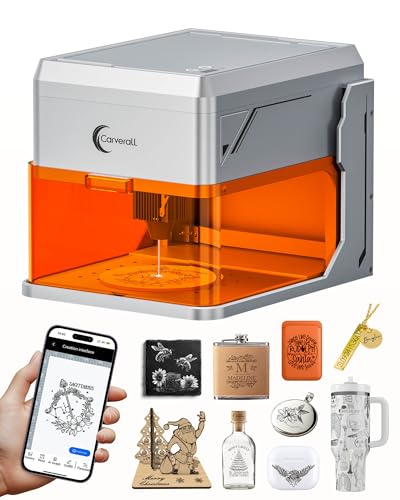
The A1 Pro is the pick for a household with kids, combining a fully enclosed Class 1 shell with a built-in camera for placing designs.
Best for: households with kids who want camera-assisted placement Skip it if: you need published weight and size figures before buying
Placement is the quiet frustration of small-bed engraving. You line up a dog tag by eye, run the job, and the text sits 2mm off centre. Carverall builds a camera into the A1 Pro so you can see the blank on screen and drop the design onto it. Of the six picks, this is the only one with that feature.
Carverall claims 12W optical output, verified in their copy at 12.36 to 12.58W, on a 3.94x3.94-inch work area with speeds to 12,000 mm/min. The listing also describes tilt protection, built-in air assist and a removable base, and says the machine is roller-ready for cylindrical items. Air assist inside an enclosed body is a genuinely useful combination, because it clears smoke that would otherwise stain the workpiece. The stated 1 year warranty with lifetime tech support matches the ATOMSTACK on paper.
It sells faster than every other pick in this group, and it is the only one with more than one seller listed. That is worth knowing when a single-seller listing goes quiet.
Trade-off against the set: this is the thinnest specification sheet here. No published weight, no published dimensions, no colour beyond the power label. You get the highest claimed power of the small-bed trio, but you cannot plan your shelf from the data given.
Pros:
- Only pick with a built-in placement camera
- 12W claim, highest of the small-bed machines
- Enclosed Class 1 design with tilt protection
- Built-in air assist and roller support claimed
- Several sellers stock it, unlike the rest
Cons:
- No published weight or dimensions at all
- 3.94-inch bed is the second-smallest here
- Camera adds a failure point on a budget machine
- Removable base means another part to store
3. WIZMAKER Wand 12W Laser Engraver — Most versatile
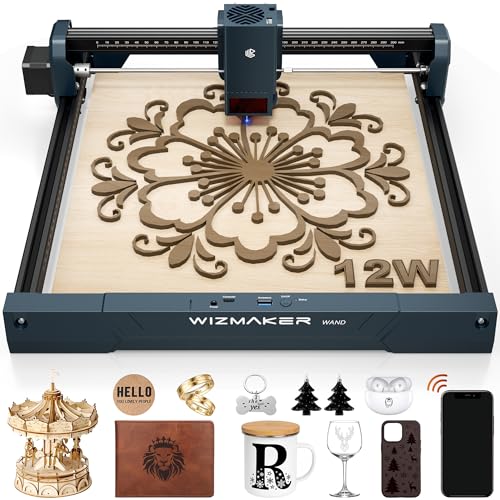
The Wand gives you a 300x300mm bed and full LightBurn support at 2 lb, which is the widest capability per pound in this comparison.
Best for: makers who want the biggest bed and LightBurn support Skip it if: you cannot set up eye protection and ventilation
This is where the category splits. The Wand's 300x300mm area is roughly seven times the surface of the Cloudray's 80x80mm bed, and it is the largest in this set. Signs, serving boards, box lids and multi-item batch runs all become possible. WIZMAKER quotes 0.1mm repeatable positioning accuracy and speeds to 10,000 mm/min at a claimed 12W.
Connectivity is the other reason it earns the versatility label. The listing covers Windows, macOS, Android and iOS, over Wi-Fi, hotspot or USB, and names both LightBurn and free LaserGRBL. LightBurn support matters more than it sounds. It is the software most experienced diode users settle on, and a machine locked to a proprietary app becomes limiting fast.
Now the catch, and it is a big one. WIZMAKER describes the Wand as a Class 4 laser with tilt detection and flame monitoring. Class 4 means the beam is not enclosed. You need proper laser goggles rated for 450nm, you need the room ventilated, and you should not run it unattended or around pets and children. The other complete machines here are described as Class 1.
Trade-off against the set: you get the largest bed and the lightest body at 2 lb, but you take on all the safety management the enclosed picks handle for you.
Pros:
- Largest work area here at 300x300mm claim
- LightBurn and LaserGRBL both supported
- Works with Windows, macOS, Android and iOS
- 0.1mm repeatable positioning claim
- 1 year manufacturer warranty stated
Cons:
- Class 4 open frame, so goggles are mandatory
- Not suitable for a shared family room
- Published dimensions of 3.94 x 3.94 x 1.97 in describe packaging, not the frame
- Only one seller lists it
4. Cloudray 5W Diode Laser Engraver Machine — Best warranty
The Cloudray BM1 pairs a 12 month manufacturer warranty with the tightest accuracy claim in this group, 0.01mm, on a small enclosed bed.

Best for: small keepsakes, PCB labels and classroom projects Skip it if: your designs are wider than 80mm
The BM1 is the second-cheapest pick here and the only complete machine that publishes real, usable external dimensions: 7.39 x 9.03 x 8.93 in. That sounds like a small point until you try to plan a shelf from the other listings and find placeholder numbers.
Cloudray claims a Class 1 fully enclosed design with 5W output, tilt protection and an exhaust fan, an 80x80mm engraving area, 5000 mm/min speed and 0.01mm accuracy. That accuracy figure is the tightest claim in this comparison, ten times finer than the WIZMAKER's stated 0.1mm. Software coverage is broad for the price: CutLabx, LaserGRBL and LightBurn, with LightBurn described as included. Cloudray also calls out STEM education and PCB labelling, which fits the small bed well.
The 12 month manufacturer warranty ties it with ATOMSTACK and Carverall on duration, but Cloudray's is the clearest statement of the three, and it is attached to the lowest price position of any warrantied machine here.
Trade-off against the set: 80x80mm is the smallest working area of any complete machine, and 5000 mm/min is the slowest stated speed. You are trading capability for a low entry cost, an enclosure and a warranty.
Pros:
- Tightest accuracy claim here at 0.01mm
- Class 1 enclosure with exhaust fan and tilt protection
- LightBurn described as included
- Second-cheapest of the six
- Only complete machine with credible published dimensions
Cons:
- 80x80mm bed is the smallest here
- 5000 mm/min is the slowest stated speed
- 5W ceiling limits cutting depth
- Only one seller lists it
5. LASER TREE 4W Laser Engraver Module — Best budget pick
This is a 4W laser module, not a machine, and it is the cheapest way into diode engraving if you already own a frame.
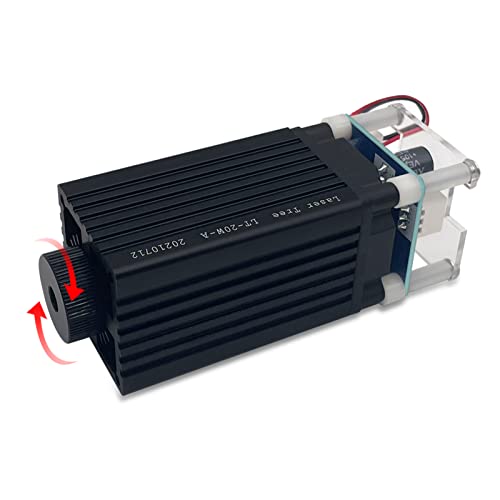
Best for: anyone with an existing CNC frame to bolt a laser onto Skip it if: you want a finished machine out of the box
Be clear about what this is. The LASER TREE is a bare 450nm laser module weighing 3.53 oz, measuring 2.36 x 4.72 x 2.36 in in the box, with the module itself quoted at 35x99.6mm in the feature text. There is no bed, no gantry, no controller and no enclosure. It bolts onto a CNC router or a 3D printer frame you already have.
For that specific buyer it is the smartest purchase in this comparison. LASER TREE claims 4W optical output with an adjustable focus range of 20mm to 50mm, an original diode with FAC for beam quality, and 12V 1.6A input. The material list covers MDF, wood, paper, leather, bamboo, plastic, rubber, alumina and stainless steel. Your work area becomes whatever your existing frame allows, which for a mid-size CNC is far larger than anything else here.
For anyone without a frame, this is not a purchase. It is a component. Adding a controller, rails and power supply costs more than several complete machines in this set.
Trade-off against the set: the cheapest of the six and the lightest by a wide margin, but the only one that cannot engrave anything on its own. No warranty is stated, and no enclosure means Class 4 handling.
Pros:
- Cheapest pick of the six
- 3.53 oz, easy to mount on almost any frame
- Adjustable focus from 20mm to 50mm
- Broad claimed material list including stainless steel
Cons:
- Not a complete machine, no bed or controller
- No warranty stated on the listing
- 4W is the lowest power figure here
- Exposed beam means goggles and enclosure are on you
- Model naming mixes 4W and 20W references
6. Acmer S2 20W Laser Engraver — Best premium
The S2 brings the highest claimed power here, 20W, plus a 25L/min air assist pump on a 300x285mm bed.

Best for: cutting thicker stock with air assist included Skip it if: you want a warranty stated on the listing
If cutting rather than marking is the goal, wattage stops being a vanity number. Acmer claims a true 20W module at 455±5nm, which is 8W above the next-strongest pick here. It also claims a compressed spot of 0.09 x 0.1mm, which is the specific combination that lets a diode cut cleanly instead of burning a wide, charred kerf.
The included 25L/min air assist pump is the other reason this sits at the top of the range. Air assist blows smoke and debris out of the cut as it happens. On the picks that lack it, you either buy one separately or accept scorched edges on light woods. Only Carverall and Acmer mention air assist at all in this group.
Working area is 300x285mm per the listing, essentially matching the WIZMAKER Wand. Software is Acmer Studio, described as free and ready out of the box, which is convenient but proprietary. The WIZMAKER's LightBurn support is the more future-proof arrangement.
Trade-off against the set: the most expensive pick here, with no warranty stated and no colour or weight figure beyond the model label. It also sells the slowest of the six, so treat the single-seller listing as worth checking before you commit.
Pros:
- Highest claimed power at 20W
- 25L/min air assist pump included
- 0.09 x 0.1mm compressed spot claim
- 300x285mm working area, near the largest here
Cons:
- No warranty stated on the listing
- Software is proprietary rather than LightBurn
- The slowest seller of the six, with one seller only
- Published dimensions of 0.04 x 11.8 x 11.2 in are not usable
- Highest price position with no enclosure mentioned
How much desk space does each one really need?
This is where the listings let buyers down, so read the specifications carefully before you clear a shelf.
- Cloudray BM1: 7.39 x 9.03 x 8.93 in published. The only complete machine here with a figure you can plan around.
- ATOMSTACK P1: published dimensions read 1 x 1 x 1 in, which is a placeholder. The feature text quotes 265x303x185mm, and at 4.85 lb it is easy to move.
- WIZMAKER Wand: 2 lb, with published dimensions of 3.94 x 3.94 x 1.97 in that describe packaging rather than a 300x300mm frame.
- Acmer S2: published as 0.04 x 11.8 x 11.2 in. The 0.04 figure is not real, but the 11.8 and 11.2 inch values are consistent with a 300x285mm bed.
- Carverall A1 Pro: no dimensions or weight published. The feature text mentions 27cm height.
- LASER TREE module: 2.36 x 4.72 x 2.36 in boxed, 3.53 oz. Space depends entirely on your frame.
Practical rule: an open-frame machine needs roughly twice its bed dimensions in clear space, because the gantry travels beyond the work area and you need room to reach in. An enclosed machine needs its own footprint plus a hand's width. Add a further margin for the exhaust duct if you plan to vent out a window, which you should.
Enclosed or open frame: which should you buy?
This choice affects your daily life with the machine more than any spec on the box.
Enclosed, described as Class 1: ATOMSTACK P1, Carverall A1 Pro, Cloudray BM1. The beam stays inside during normal use. You can run these in a room where other people are. Four of the six picks in this budget diode laser engraver comparison are enclosed, which is a genuine shift from a few years ago when open frames dominated the entry tier.
Open frame, Class 4: WIZMAKER Wand, and the LASER TREE module by definition. The beam is exposed. Goggles rated for the wavelength are not optional, reflections off shiny stock are a real hazard, and children and pets need to be out of the room.
The honest trade is bed size. Enclosed machines in this price territory top out around 4 inches square, because the shell has to grow with the bed and shells are expensive. If you want a foot of working width without spending far more, you accept an open frame and manage the safety yourself.
Ventilation applies either way. Diode engraving on MDF, leather and plastic produces smoke you do not want to breathe. Budget for a window duct or an inline fan regardless of which route you take.
What the listings do not tell you
A few things are worth naming plainly, because none of these listings mention them.
Clear acrylic will not cut. Blue diode lasers pass straight through it. Every listing here that mentions acrylic specifies dark or opaque acrylic, and the Cloudray adds that backing paper is needed. If clear acrylic is your material, no diode machine solves it.
Bare metal marking needs the right head. The ATOMSTACK P1's 1.2W infrared module is the only source in this set designed for that job. Where other listings mention metal, they generally mean coated or anodised surfaces where the laser removes a layer.
"12W" and "20W" mean optical output, not wall draw. Compare like with like across brands, and note that Carverall is the only one here quoting a measured range rather than a round number.
Software matters as much as hardware. LightBurn is the common language of diode engraving. The WIZMAKER and Cloudray listings both name it. Acmer ships its own studio software instead, which works but keeps you inside one vendor's ecosystem.
Modifier honesty: "budget" is your judgement, not a specification. These six span the cheapest bare module to a fully specified 20W machine, and the price positions do not always track capability. The Cloudray sits near the bottom of this range while publishing more usable data than the two priciest picks.
The verdict
The ATOMSTACK P1 is the best budget diode laser engraver here because it solves the problem that actually stops beginners: where do you put it, and can you run it with someone else in the room. An enclosed Class 1 body, a 110x110mm bed, a 1.2W infrared source alongside the 5W diode, 4.85 lb of weight and a stated 1 year warranty add up to a machine you will actually switch on.
Two conditions flip that. First, if your designs are wider than roughly 4 inches, the P1 cannot help you at any speed, and the WIZMAKER Wand's 300x300mm bed with LightBurn support becomes the right answer. Accept the Class 4 handling that comes with it, buy 450nm goggles, and vent the room. Second, if you already own a CNC or a 3D printer frame, the LASER TREE 4W module is the cheapest sensible entry point in this whole comparison, and your existing gantry gives you a larger bed than anything else listed.
The WIZMAKER's exact advantage over the P1 is area, not power. Seven times the working surface at a claimed 12W, for a lower price position, in a body weighing 2 lb. What it does not give you is a shell between the beam and the room.
FAQ
Is a budget diode laser engraver worth buying?
A budget diode laser engraver is worth buying if your materials are wood, leather, MDF, bamboo, paper or coated metal, and your pieces are small. These six range from a 4W module to a 20W machine with air assist. What none of them will do is cut clear acrylic or mark bare steel without an infrared head, so match the machine to the material first.
What is the cheapest way into diode laser engraving?
The cheapest way in is the LASER TREE 4W module, which is the lowest price position of these six. It weighs 3.53 oz and bolts onto a CNC or 3D printer frame you already own. Without a frame, it is not a shortcut, because a controller, rails and power supply push the total above several complete machines in this set.
How much power do I need to cut wood rather than engrave it?
To cut wood rather than engrave it, power and spot size both matter. The Acmer S2 claims 20W with a compressed 0.09 x 0.1mm spot and includes a 25L/min air assist pump, which is the combination built for cutting. The 5W picks here, the ATOMSTACK P1 and Cloudray BM1, are surface-marking machines with light cutting at best.
ATOMSTACK P1 or WIZMAKER Wand: which should I pick?
Between the ATOMSTACK P1 and WIZMAKER Wand, the P1 wins on containment and the Wand wins on size. The P1 is an enclosed Class 1 machine with a 110x110mm bed and a dual diode plus infrared head. The Wand is an open Class 4 frame with a 300x300mm bed, 12W claimed, and LightBurn support. Shared room means P1.
Do I need ventilation for a small enclosed laser engraver?
You need ventilation for a small enclosed laser engraver, yes. An enclosure contains the beam, not the smoke. The Cloudray BM1 lists an exhaust fan and Carverall lists built-in air assist, but both still push fumes into the room unless you duct them out. Engraving MDF, leather and plastic produces particulates worth venting through a window on every job.
Start by writing down the largest single item you want to engrave, then measure it. If it fits inside 4 inches square, the ATOMSTACK P1 is the sensible default in this group, because the enclosure removes the goggles-and-clear-the-room ritual that stops open-frame machines getting used. If it does not fit, the choice is already made for you and the WIZMAKER Wand's 300x300mm bed is where to look. Either way, order the ducting at the same time as the machine. The people who abandon these things rarely blame the laser. They blame the smoke.