Best CO2 Laser Engraver for Graphic Designers

Six engraving machines, ranked for people who work in vector files all day. The OMTech K40+ 45W leads on cut depth and bed size, but two of these picks are not CO2 machines at all, and that changes what they can do.

By Ash MoralesUpdated 17 min read
On this page
- Best CO2 laser engraver for graphic designers at a glance
- How six machines were cut down from a much longer list
- Does a designer actually need a CO2 tube?
- 1. OMTech K40+ 45W Desktop CO2 Laser Engraver & Cutter — Best overall
- 2. xTool M2 10W Laser Engraver — Runner-up
- 3. OMTech Maker 60W CO2 Laser Engraver with LightBurn & Water Chiller — Best premium
- 4. VEVOR 60W CO2 Laser Engraver — Best for pros
- 5. VEVOR 45W CO2 Laser Engraver — Best minimal setup
- 6. LASER TREE 20W Laser Engraver & Cutter — Best budget pick
- Which bed size matches the work you already do?
- What the listings do not tell you about setup
- When a different pick wins
- The verdict
- FAQ
The best CO2 laser engraver for graphic designers is the OMTech K40+ 45W, because it pairs a 12 x 8 in bed with enough power to cut 10mm acrylic in one pass, which is what turns a vector file into a physical prototype. The xTool M2 10W is the pick if you have no extractor and no room, since it ships as a Class 1 enclosed unit with a 1 Year warranty. Neither is right for everyone here. If your studio is a spare bedroom and your deliverables are all screen-based, you probably want a print bureau and a courier account instead of a 242.5 lb machine and a ventilation duct through the wall. This guide is for designers who have decided they want to make the thing themselves.
Best CO2 laser engraver for graphic designers at a glance
| Pick | Power | Work area | Price |
|---|---|---|---|
| 45W | 12 x 8 in claim | Check Price | |
Runner-up xTool M2 10W Laser Engraver |
10W diode | Enclosed desktop | Check Price |
| 60W | 20 x 28 in claim | Check Price | |
Best for pros VEVOR 60W CO2 Laser Engraver |
60W | 24 x 16 in claim | Check Price |
Best minimal setup VEVOR 45W CO2 Laser Engraver |
45W | 12 x 8 in claim | Check Price |
Best budget pick LASER TREE 20W Laser Engraver & Cutter |
20W diode | 15.75 x 31.5 in | Check Price |



How six machines were cut down from a much longer list
Three things knocked candidates out before power ever came up.
The first was software. A designer already owns a vector workflow, so a machine that only accepts its own proprietary file format is a machine that adds an export step to every job. Every pick here names either LightBurn, CorelDRAW, RDWorks or LaserGRBL in its listing, and the OMTech Maker bundles LightBurn outright.
The second was published dimensions. Four of the six list a full footprint, and that number decides whether the machine goes in your studio or does not. The VEVOR 60W is 27.8 x 46.1 x 32.3 in. That is a piece of furniture.
The third was honesty about what the machine is. Two of these six are diode units, not CO2 tubes, and the listings say so. I kept them because they solve real problems for designers, but they are labelled clearly below rather than blended in.
What survived: four CO2 tube machines across 45W and 60W, and two enclosed diode units at 10W and 20W. Every one lists a work area or a footprint I could compare directly against the others.
Does a designer actually need a CO2 tube?
This is the question that decides your purchase, and the specification most guides lead with, wattage, will mislead you if you skip it.
A CO2 tube and a diode laser produce light at different wavelengths, and that changes what the beam does to a material. Clear acrylic is the classic split: it absorbs the CO2 wavelength readily, so a CO2 machine cuts it, and it largely passes the blue diode wavelength through, which is why diode machines struggle with it unless the acrylic is dark or tinted.
For a designer, that maps neatly onto deliverables:
- Acrylic signage, layered awards, clear display stands. CO2. Non-negotiable.
- Wood coasters, leather tags, engraved plywood, card, felt. Either type handles these.
- Anodised or coated metal marking. Neither of these six is sold for bare metal, and the xTool M2's listing points to a separate 3W IR module, sold separately, for fine marking.
- Photographic raster engraving on wood. Both types do it. Speed differs.
So the honest answer is that 45W of CO2 beats 20W of diode on acrylic by a wide margin, and the two numbers are not comparable at all. A 20W diode is not "less than half" a 45W tube. It is a different tool.
Note the qualifier in the search term too. None of these listings is described as built for graphic designers specifically, and no machine here claims a design-suite integration beyond the standard software names. Treat "for graphic designers" as your own filter on file compatibility and bed size, not a feature anyone is selling you.
1. OMTech K40+ 45W Desktop CO2 Laser Engraver & Cutter — Best overall
The K40+ hits the sweet spot for design work: enough CO2 power to cut 10mm acrylic, in a body that still fits on a bench.
Best for: designers cutting acrylic prototypes and signage Skip it if: your artwork routinely runs wider than 12 in
Among the four CO2 machines here, this is the one that does not demand a workshop. Its footprint is 9.8 x 31.9 x 19.7 in, which is a shelf, not a room. The two 60W picks measure 27.8 x 46.1 x 32.3 in and 36.6 x 47.2 x 34.3 in respectively, so the K40+ takes a fraction of the space for two thirds of the wattage.
OMTech puts the 45W tube to specific work in its listing: 0.4 in (10mm) acrylic and 0.31 in (8mm) wood, with engraving speeds quoted up to 300 mm/s. Those are the manufacturer's numbers, but they are unusually concrete for this category, and 10mm acrylic covers most layered signage and prototype casework a studio produces. The listed 12 x 8 in work area is the real ceiling on what you can lay out. A2 artboards are not happening.
The air assist is described as a built-in 45° system that adjusts airflow to laser power, which matters for keeping soot off engraved acrylic faces.
It also sells faster than any other CO2 machine in this set. What it gives up is bed size and any published warranty term.
Pros:
- 45W CO2 tube, cuts clear acrylic
- Smallest footprint of the four CO2 picks
- 10mm acrylic and 8mm wood cutting claims
- 300 mm/s engraving speed claim
- Built-in 45° air assist
Cons:
- 12 x 8 in bed is the smallest here alongside the VEVOR 45W
- No warranty term published in the listing
- No weight listed, so plan the bench blind
- Only one seller lists it
- No autofocus, unlike the OMTech Maker
2. xTool M2 10W Laser Engraver — Runner-up
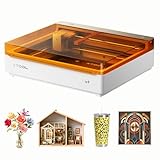
The M2 is not a CO2 machine, and that is exactly why it fits studios where a CO2 machine cannot go.

Best for: studios with no ventilation and no floor space Skip it if: you need to cut thick acrylic
Say the constraint out loud: a lot of designers work in a rented flat or a shared office. A 45W CO2 tube needs extraction and a water loop. The M2 is listed as Class 1 fully enclosed with real-time monitoring, which is the safety class you want when the machine sits three feet from where you take client calls.
The dual built-in cameras are the feature a designer will notice most. xTool describes them as giving a real-time preview of the workspace, which is how you place a vector on an already-cut object instead of guessing at origin coordinates. The listing also names xTool Studio, with template libraries and an AI image generator, plus optional modules: a CMYK inkjet head and a 3W IR laser, both sold separately.
It carries a 1 Year warranty, one of only three published warranty terms in this set, and it is the fastest-selling machine here by a large margin.
The trade-off is fundamental. A 10W diode will not do clear acrylic the way the CO2 picks will, and the listing gives no work-area figure at all, so you are buying on the enclosure, not the bed.
Pros:
- Class 1 enclosed, no external extraction implied
- Dual cameras for live workspace preview
- 1 Year warranty published
- Modular: CMYK inkjet and 3W IR available separately
- The machine buyers here choose most often
Cons:
- 10W diode, not a CO2 tube
- Clear acrylic is a poor fit for this wavelength
- No work area or weight listed
- The useful modules cost extra
- Lowest raw power in the set
3. OMTech Maker 60W CO2 Laser Engraver with LightBurn & Water Chiller — Best premium
The only pick that arrives as a complete system: 60W tube, water chiller, LightBurn licence and autofocus in one box.

Best for: a studio running paid client work daily Skip it if: the machine has to live in a spare bedroom
This is the most expensive pick here, and it is the only one whose listing bundles the parts that usually turn up as three separate purchases. Count is listed as 2, because the chiller ships alongside the machine. LightBurn comes with it, which removes the software line item most designers hit on day one.
Autofocus is the working advantage. OMTech describes powered workbed height adjustment at the touch of a button, and if you cut varied stock thicknesses, that is minutes saved per job and one fewer source of ruined material. The listed work area is 20 x 28 in across honeycomb and aluminium blade beds, so it handles longer signage than the 12 x 8 in desktop picks.
It also carries the strongest published warranty in the set: 2 Years, with 6 Months for parts.
Now the reality check. It weighs 249 lb and measures 36.6 x 47.2 x 34.3 in, making it the largest and heaviest machine here. You need a floor, a door wide enough, and someone to help. It sells more slowly than the K40+ and the xTool.
Pros:
- 60W CO2 with 20 x 28 in stated work area
- Water chiller included in the box
- LightBurn licence bundled
- Powered autofocus workbeds
- 2 Years warranty, longest published here
Cons:
- 249 lb and the biggest footprint in the set
- The most expensive pick here
- Parts coverage drops to 6 Months
- Needs dedicated floor space and extraction
- Overkill for occasional prototype work
4. VEVOR 60W CO2 Laser Engraver — Best for pros
Four-way pass-through is the feature that separates this one: you can feed stock longer than the machine.

Best for: cutting long leather and wood stock in a workshop Skip it if: you want a published warranty
The stated work area is 24 x 16 in, but the number that matters is the four-way pass-through design, which VEVOR describes as allowing longer materials and manual feeding. For a designer producing long panels, leather straps or rolled goods, that removes the bed dimension as a hard limit. None of the other five picks lists pass-through on all four sides.
Model SH-460 is listed as compatible with LightBurn, CorelDRAW and RDWorks, and VEVOR states Windows, macOS and Linux support with USB connection. The CorelDRAW mention is worth flagging: if your studio already builds cut files in Corel, that shortens the path from artboard to bed.
Focusing is manual, adjusted at the control panel or by raising and lowering the worktable. Air assist is built in.
At 242.5 lb and 27.8 x 46.1 x 32.3 in, this is the second-largest machine in the set. Its warranty field reads "Not applicable", so there is no term to plan around, and it is the slowest-selling pick of the six. Against the OMTech Maker, you lose the chiller, the bundled LightBurn licence and autofocus.
Pros:
- 60W CO2 with 24 x 16 in bed
- Four-way pass-through for oversized stock
- Names CorelDRAW, LightBurn and RDWorks
- Windows, macOS and Linux support stated
- Built-in air assist
Cons:
- No warranty term published
- 242.5 lb, needs permanent floor space
- Manual focusing only
- No chiller or software bundled, unlike the OMTech Maker
- The slowest seller of the six
5. VEVOR 45W CO2 Laser Engraver — Best minimal setup
Same wattage and same bed as the winner, with a rotary axis named in the listing.

Best for: designers who want a rotary axis included Skip it if: you need autofocus or a chiller
Model SH-3020 lines up almost exactly with the OMTech K40+ on paper: 45W, a 12 x 8 in work area, built-in air assist, a desktop footprint of 10.2 x 31.9 x 20.5 in. The differentiator is the rotary axis named in its full listing, which is the attachment that turns a tumbler, a bottle or a candle jar under the beam. If cylindrical merch is part of your client work, that changes the maths.
VEVOR states Windows, macOS and Linux compatibility, plus LightBurn, CorelDRAW and GRBL support, and describes plug-and-play operation over USB. Focusing is manual: a precision knob, red-dot positioning and a focusing scale. Red-dot positioning is the practical bit, because it shows you where the beam will land before you commit.
Weight is listed at 64 lb, which is a two-person lift onto a bench but not a floor-standing install.
Where it loses to the K40+ is specificity. OMTech publishes cutting depths and an engraving speed figure; this listing describes burr-free edges and small-project suitability without giving you numbers to plan against. Warranty reads "Not applicable".
Pros:
- 45W CO2 at 64 lb, benchtop-friendly
- Rotary axis named in the listing
- Red-dot positioning and focusing scale
- LightBurn, CorelDRAW and GRBL named
- Windows, macOS and Linux stated
Cons:
- No warranty term published
- No cutting depth or speed figures given
- Manual focusing, no powered bed
- 12 x 8 in bed limits panel work
- No chiller included, unlike the OMTech Maker
6. LASER TREE 20W Laser Engraver & Cutter — Best budget pick
The cheapest of the six, and the one with the longest bed: 15.75 x 31.5 in of open work area.
Best for: trying laser work before committing budget Skip it if: clear acrylic is central to your work
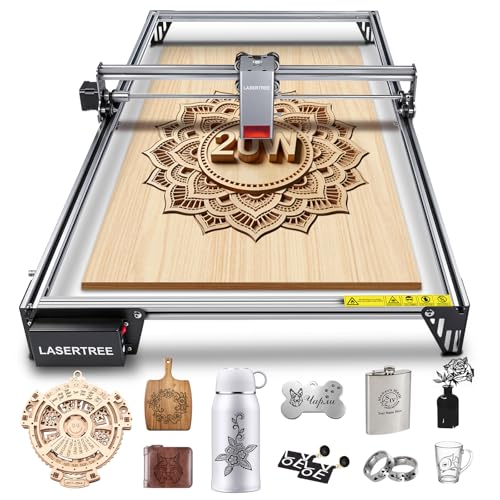
The K1 Mini Plus is the cheapest of the six and it still gives you the longest single dimension in the set: a stated 400x800mm, or 15.75 x 31.5 in, work area. For engraving long wooden signs or laying out a sheet of coasters in one run, that beats the 12 x 8 in CO2 desktops outright.
LASER TREE describes 3-beam combined compression producing 20W real optical power, and quotes a maximum engraving speed of 10000mm/min. The listing names LightBurn and LaserGRBL, with Windows and Mac support, and lists wood, acrylic, leather, fabric and cardboard as supported materials. It carries a 1 year warranty, which is more than three of the CO2 picks publish.
Two caveats matter more than the price. First, this is a diode, so the acrylic capability the CO2 picks give you is not comparable here, and dark or tinted stock will behave very differently from clear. Second, the frame dimensions of 5.87 x 31.5 x 31.8 in suggest an open gantry rather than the enclosed body of the xTool M2, so plan for eye protection and extraction of your own.
Pros:
- Cheapest of the six
- 15.75 x 31.5 in work area, longest here
- 10000mm/min engraving speed claim
- 1 year warranty published
- LightBurn and LaserGRBL named
Cons:
- 20W diode, not a CO2 tube
- Clear acrylic is not its strength
- Open frame implied, no enclosure stated
- No weight listed
- Fewest published specifications for cut depth
Which bed size matches the work you already do?
Designers overestimate the bed they need and underestimate the room the machine takes. Here is the ranking by stated work area, largest first:
- OMTech Maker 60W — 20 x 28 in, and the largest single area here
- VEVOR 60W — 24 x 16 in, plus four-way pass-through
- LASER TREE 20W — 15.75 x 31.5 in, longest but narrow
- OMTech K40+ 45W — 12 x 8 in
- VEVOR 45W — 12 x 8 in
- xTool M2 10W — no figure published
Map that onto real deliverables. Coasters, keychains, jewellery blanks, leather tags and business-card-scale test cuts all sit comfortably inside 12 x 8 in, which covers a lot of a designer's physical output. Layered acrylic awards and desk signage usually do too.
The moment you need more is when you start cutting panels: shopfront lettering, exhibition graphics, model architecture, anything derived from an A3 or larger artboard. That is a 60W conversation, and both 60W picks weigh over 240 lb.
The LASER TREE is the interesting outlier, because 31.5 in of length at the cheapest price in the set is a lot of runway for long sign blanks, as long as the 20W diode suits your material.
What the listings do not tell you about setup
Four gaps show up repeatedly across these six listings, and each one costs you either money or a weekend.
Extraction. Every CO2 pick here mentions built-in air assist. Air assist blows debris away from the cut point. It is not the same as an inline fan and a duct that takes smoke out of the building, and no listing here specifies the exhaust hardware you will need.
Cooling. Only the OMTech Maker names a water chiller, listed as part of a two-item bundle. The other CO2 machines do not state their cooling arrangement, so budget the question rather than the answer.
Weight and access. The OMTech Maker at 249 lb and the VEVOR 60W at 242.5 lb are not going up a narrow staircase without help. The VEVOR 45W at 64 lb is manageable. The K40+, the xTool M2 and the LASER TREE publish no weight at all.
Software licence. LightBurn is bundled only with the OMTech Maker. The other listings name compatibility, which is a different thing from inclusion.
Materials. No CO2 or diode machine in this set is sold for PVC or vinyl, and cutting chlorinated plastics in any laser is a bad idea for the machine and the room.
When a different pick wins
The winner is the default, not the answer for everyone. Three thresholds flip it.
- If your finished pieces regularly exceed 12 in in either direction, the K40+ bed becomes the bottleneck within a month. Move to the OMTech Maker 60W for its 20 x 28 in area, or the VEVOR 60W if pass-through feeding of long stock matters more than a chiller.
- If your workspace has no window, duct route or dedicated floor, no CO2 tube is the right buy and the xTool M2 10W is. Class 1 enclosure and dual cameras beat raw wattage you cannot safely run.
- If you are unsure whether laser work will stick, start with the LASER TREE 20W. Cheapest here, a 1 year warranty, and 15.75 x 31.5 in of bed to find out what you actually make.
One more flip. If cylindrical products, tumblers, bottles, candle jars, are part of the plan, the VEVOR 45W names a rotary axis and the K40+ does not. Same wattage, same bed, different capability.
The verdict
The OMTech K40+ 45W is the best CO2 laser engraver for graphic designers because it resolves the tension every studio hits: real CO2 cutting capability in a 9.8 x 31.9 x 19.7 in body you can put on a bench. OMTech states 10mm acrylic and 8mm wood cutting, plus engraving to 300 mm/s, and those figures cover the great majority of what a design studio actually fabricates. It is also the fastest-selling CO2 machine of the four here.
Two conditions flip that recommendation, and both are about your room rather than your work. If you cannot vent smoke outside, buy the xTool M2 10W instead: its Class 1 enclosure, dual cameras and 1 Year warranty make it the only pick that belongs in an unventilated shared space, and you accept that clear acrylic is off the menu. If you have a workshop floor and paying clients, the OMTech Maker 60W earns its price position. Its exact advantage over the K40+ is completeness: a 20 x 28 in work area, autofocus workbeds, a bundled water chiller, a LightBurn licence and 2 Years of coverage. That is three separate purchases collapsed into one, at 249 lb.
FAQ
Is a CO2 laser engraver worth it for a design studio?
A CO2 laser engraver is worth it if you sell or present physical objects rather than files. Acrylic prototypes, signage, layered awards and packaging mockups all come off a 45W machine like the OMTech K40+ in minutes instead of days at a fabricator. If your output is entirely digital, the machine will sit idle and a bureau makes more sense.
What is the best CO2 laser engraver for graphic designers on a tight budget?
On a tight budget, the pick is the LASER TREE 20W, the cheapest of the six here. It is a diode rather than a CO2 tube, so clear acrylic is a weak point, but it publishes a 1 year warranty and a 15.75 x 31.5 in work area, which is longer than either 12 x 8 in CO2 desktop. Good way to test whether laser work fits your practice.
Does a CO2 laser engraver work with CorelDRAW and LightBurn files?
CO2 laser engravers here work with mainstream design software rather than proprietary formats. Both VEVOR machines name CorelDRAW and LightBurn in their listings, the VEVOR 60W adds RDWorks, and the OMTech Maker ships with a LightBurn licence included. The LASER TREE names LightBurn and LaserGRBL. Check the named software list before you buy, because inclusion and compatibility are different things.
OMTech K40+ or xTool M2: which suits a small studio better?
OMTech K40+ or xTool M2 comes down to ventilation, not power. The K40+ is a 45W CO2 tube that cuts clear acrylic and needs extraction. The xTool M2 is a 10W diode in a Class 1 enclosure with dual cameras and a 1 Year warranty, designed for rooms where ducting is not an option. Pick the enclosure if you rent.
What mistake do first-time laser buyers make most often?
The most common mistake is buying wattage and ignoring the footprint. The two 60W picks here weigh 242.5 lb and 249 lb, and the OMTech Maker measures 36.6 x 47.2 x 34.3 in. Measure your doorway and your floor before you compare tubes. The second mistake is assuming built-in air assist replaces a real exhaust duct. It does not.
Start by measuring the largest thing you plan to make, then the space you have to put a machine. Those two numbers decide this faster than any specification sheet. If both come in under 12 in and you want to cut clear acrylic, the OMTech K40+ 45W is the machine that turns your vector files into physical parts without turning your studio into a workshop. It is the only pick here that gives you CO2 capability and a benchtop footprint in the same purchase, and that combination is rarer in this category than the wattage numbers suggest.