Best Fish Finders: Garmin Striker 4 Leads

A ranked comparison of seven fish finders built on published specs, from an 8 oz Garmin Striker 4 to a 9-inch Humminbird XPLORE with MEGA Side Imaging+. Screen size, mounting, warranty and who each one actually suits.

By Ash MoralesUpdated 19 min read
On this page
- Best fish finders at a glance
- How I screened these fish finders
- What each price tier actually buys you
- Does screen size matter more than sonar?
- 1. Garmin 010-01550-00 Striker 4 with Transducer — Best overall
- 2. Humminbird XPLORE 9 GPS Fish Finder with Transducer — Best premium
- 3. Humminbird Helix 5 G3 GPS Fish Finder with Transducer — Best for pros
- 4. Garmin Striker Vivid 7cv — Runner-up
- 5. Lowrance Eagle 4X Fish Finder with Bullet Transducer — Best for beginners
- 6. Venterior Portable Rechargeable Fish Finder — Best for heavy use
- 7. LUCKY Kayak Portable Fish Depth Finder — Best budget pick
- Fixed-mount or castable: which fish finder fits your boat?
- What the listings don't tell you
- The verdict
- FAQ
The best fish finders for most boats are the Garmin Striker 4, because an 8 oz, 5.9 x 3.6 x 1.6 in head unit puts CHIRP sonar and GPS waypoints on a console without a rebuild. If you fish big water and want MEGA Side Imaging+ scanning 200 feet to each side, the Humminbird XPLORE 9 is the better buy. The price tiers here split cleanly. Entry gets you a castable or clip-on sensor with depth and fish icons. The middle gets you a mounted screen with sonar and satellite positioning. Premium buys screen real estate, side-scanning and preloaded lake maps.
Best fish finders at a glance
| Pick | Screen | Sonar & navigation | Price |
|---|---|---|---|
Best overall Garmin Striker 4 |
3.5 in 1.9 x 2.9 in view |
CHIRP + ClearVü GPS waypoints |
Check Price |
Best premium Humminbird XPLORE 9 |
9 in 1280 x 720 |
MEGA Side Imaging+ 200 ft claim GPS + LakeMaster card |
Check Price |
Best for pros Humminbird Helix 5 G3 |
5 in | Dual Spectrum CHIRP GPS + Basemap |
Check Price |
Runner-up Garmin Striker Vivid 7cv |
7 in colour | CHIRP + ClearVü GPS + Quickdraw |
Check Price |
Best for beginners Lowrance Eagle 4X |
4 in IPS portrait | 200 kHz, 44-degree beam claim No GPS listed |
Check Price |
Best for heavy use Venterior VT-FF005 |
Colour, 2 backgrounds | Wireless sonar, 262 ft claim No GPS listed |
Check Price |
Best budget pick LUCKY FFC1108 |
LCD handheld | Castable sonar, fish alarm No GPS listed |
Check Price |



How I screened these fish finders
I lined up every published specification side by side, then sorted the seven into two piles: units that bolt to a boat and units you hold or cast. Those two piles answer different questions, so comparing them on screen size alone is a mistake.
Four screening criteria did the work:
- Does the listing publish a screen size in inches? Five of the seven do. The LUCKY and the Venterior describe their displays without giving a diagonal.
- Is satellite positioning stated? Four units say yes: the Striker 4, the Striker Vivid 7cv, the Helix 5 G3 and the XPLORE 9. That single line splits the field harder than anything else.
- Is a transducer included? Every one of the seven ships with a sensor of some kind, which is why none was cut on that basis.
- Is there a stated warranty? Six publish one. The LUCKY listing does not, and that's the only pick here missing it.
A note on the search term. Plenty of shoppers arrive at "best fish finders" wanting one specific thing, whether that's ice fishing, a kayak mount or saltwater depth. The listings don't line up neatly behind any single one of those, so I've flagged what each unit's own specifications actually support and left the rest to you. Where a claim comes from the manufacturer's bullet rather than a measured figure, I say so.
What each price tier actually buys you
The seven picks fall into three groups, and the jump between them is not subtle.
The three cheapest are the LUCKY FFC1108, the Venterior VT-FF005 and the Lowrance Eagle 4X. All three give you depth and something resembling fish detection. None of the three lists satellite positioning, so you can find a hump but you can't save it and come back. The Venterior weighs 0.94 lb and the LUCKY measures 4.8 x 2.68 x 1.18 in, which tells you what these are: pocket tools.
The middle of this set is a single unit, the Garmin Striker 4. It's the only pick that combines a mounted screen, CHIRP sonar and a waypoint map without landing in the top price tier. That's the whole reason it wins.
The three most expensive are the Helix 5 G3, the Striker Vivid 7cv and the XPLORE 9. What the money buys is measurable. Screens go from 3.5 in to 5, 7 and 9 inches. The XPLORE 9 publishes 1280 x 720 resolution and a three-year warranty with registration. The Vivid 7cv publishes two years. Preloaded cartography arrives too: Humminbird cites Basemap coverage of 10,000-plus lakes on both of its units.
Does screen size matter more than sonar?
Most fish finder comparisons rank by screen diagonal, and I understand why. It's the easiest number to read off a box. It's also the wrong first question.
Every mounted pick here runs some form of CHIRP sonar, so the sonar isn't what separates them. What separates them is whether the unit can remember where you were. The Striker 4 publishes a waypoint map for marking brush piles, stumps and docks. The Lowrance Eagle 4X, with a larger 4-inch IPS screen, publishes no positioning at all. Bigger screen, less capability.
Screen size matters at the extremes. A 3.5-inch display measuring 1.9 x 2.9 in is genuinely tight if you want a split view of sonar and map. A 9-inch panel at 1280 x 720 is a different experience. Between those poles, the deciding factors are:
- Whether GPS and waypoints are published
- Whether side-scanning is offered, which only the XPLORE 9 claims here
- Whether the housing fits your console, from 5.9 x 3.6 x 1.6 in to 9.63 x 15.8 x 4.75 in
- Whether the warranty runs one, two or three years
Sort on those four and the ranking looks nothing like a screen-size list.
1. Garmin 010-01550-00 Striker 4 with Transducer — Best overall
A 3.5-inch head unit weighing 8 oz that still delivers CHIRP sonar, ClearVü scanning and a usable waypoint map, which is why it's the default for most small boats.
Best for: small-boat anglers who want GPS waypoints without a big install Skip it if: you need colour palettes or a screen bigger than 3.5 inches
Here's what makes this the pick of the seven. It's the only unit in the set that pairs a mounted display, CHIRP sonar and a waypoint map without sitting in the top price tier. Garmin lists maximum depth at 1,600 feet in freshwater and 750 feet in saltwater, plus a built-in flasher view the company describes as suited to ice fishing and vertical jigging. The IPX7 water rating is stated on the listing.
The housing is 5.9 x 3.6 x 1.6 in and 8 oz. That's the lightest mounted unit here by a wide margin, since the next lightest is the 2.12 lb Helix 5 G3. On a kayak gunwale or a cramped tiller boat, that difference decides whether the thing fits at all. Control is by dedicated buttons rather than touch, which Garmin frames as the simpler approach.
The trade-off is real. Released in 2015, it carries a one-year limited warranty against the three years the XPLORE 9 offers with registration, and the 1.9 x 2.9 in viewing area is the smallest in the group. Only one seller lists it.
Pros:
- Lightest mounted unit here at 8 oz
- Waypoint map for marking brush piles and docks
- CHIRP plus ClearVü scanning sonar included
- IPX7 rating stated on the listing
- Built-in flasher view for vertical jigging
Cons:
- Smallest viewing area in the set at 1.9 x 2.9 in
- One-year warranty, the shortest published here
- No colour sonar palettes, unlike the Vivid 7cv
- Only one seller lists it
- Design dates to 2015
2. Humminbird XPLORE 9 GPS Fish Finder with Transducer — Best premium
The only pick here claiming MEGA Side Imaging+ out to 200 feet each side, on a 9-inch 1280 x 720 touchscreen backed by a three-year warranty.

Best for: serious anglers mapping structure on big water Skip it if: your console can't take a 6.26 x 11.7 in unit
This is the most expensive pick here, and it's the only one whose specification list justifies the position with capability the others simply don't publish. Humminbird claims MEGA Side Imaging+ reaching 200 feet to each side and MEGA Down Imaging+ to 200-foot depths, alongside Dual Spectrum CHIRP. No other unit in this set claims side-scanning at all.
The display is 9 inches at a stated 1280 x 720, with both touchscreen and keypad control. That dual-input approach matters on a wet, bouncing deck where gloved fingers and touch panels argue. Humminbird also lists a LakeMaster and CoastMaster VX map card for US and Canada regions, Basemap coverage of more than 10,000 lakes, and AutoChart Live with eight hours of built-in recording for depth contours, bottom hardness and vegetation. Connectivity includes high-speed Ethernet, Bluetooth and NMEA 2000, with stated integration for Minn Kota and Cannon gear.
The warranty is the best on offer: three years with registration, against one year for both the Striker 4 and the Helix 5 G3. What you give up is portability and simplicity. At 4.28 lb and 6.26 x 11.7 x 3.3 in, this is a console install, not a clip-on. It's also among the slower sellers in this group.
Pros:
- Only pick claiming MEGA Side Imaging+ to 200 ft per side
- Largest display here at 9 in, 1280 x 720 stated
- Three-year warranty with registration, longest in the set
- Touchscreen and keypad control both included
- LakeMaster and CoastMaster VX map card supplied
Cons:
- Highest price position in this group
- 6.26 x 11.7 x 3.3 in footprint needs real console space
- 4.28 lb is heaviest here alongside the Vivid 7cv
- Feature set is more than a casual pond angler will use
- Only one seller lists it
3. Humminbird Helix 5 G3 GPS Fish Finder with Transducer — Best for pros
A 5-inch keypad unit with Dual Spectrum CHIRP and Basemap cartography, built for anglers who want map data without a touchscreen.

Best for: anglers who want keypad control and lake maps on a 5-inch screen Skip it if: you want a touchscreen or side imaging
The Helix 5 G3 is the deliberate choice for people who've decided touchscreens are a liability on the water. Humminbird describes softkey menu control designed for reliable operation in any weather, and there's no touch layer to fail. Dual Spectrum CHIRP offers a Wide Mode for coverage and a Narrow Mode for detail, which the company positions as two ways to search the same water.
The mapping is the real draw at this size. Humminbird Basemap covers more than 10,000 lakes plus continental US coverage, and AutoChart Live records depth contours, bottom hardness and vegetation for up to eight hours as you run. Very few 5-inch units in this comparison offer built-in cartography of that scope. Only the XPLORE 9 goes further, and it costs considerably more.
Two things temper the recommendation. The published dimensions of 9.63 x 15.8 x 4.75 in are the largest box measurements in the set, so plan your console space before ordering. And at 2.12 lb with a one-year warranty, it asks premium money while offering less warranty than the two-year Striker Vivid 7cv. This is also the second-fastest seller here after the Striker 4.
Pros:
- Basemap coverage of 10,000-plus lakes built in
- AutoChart Live records contours and bottom hardness
- Weatherproof softkey control, no touch layer to fail
- Dual Spectrum CHIRP with wide and narrow modes
- Two sellers stock it, more than most picks here
Cons:
- One-year warranty despite premium price position
- Largest published dimensions in the set
- No side imaging, unlike the XPLORE 9
- No touchscreen option at all
- Colour not stated on the listing
4. Garmin Striker Vivid 7cv — Runner-up
A 7-inch colour fishfinder with vivid sonar palettes, Quickdraw Contours mapping and Wi-Fi, at half the warranty of the XPLORE 9 but a smaller footprint.

Best for: anglers who want a 7-inch colour screen and Wi-Fi transfers Skip it if: you fish from a kayak or a small tiller boat
The Vivid 7cv sits one step below the XPLORE 9 in price and one step below in screen size, and for a lot of anglers that's the sweet spot. Garmin's pitch is the colour palettes: multiple sonar colour schemes intended to make fish easier to separate from structure than a single-tone display allows. That's a claim from the listing, not a measurement, but no other pick here offers selectable palettes at all.
The bundled GT20-TM transducer runs Garmin CHIRP traditional sonar and CHIRP ClearVü scanning. High-sensitivity GPS marks waypoints, builds routes and reads boat speed. Quickdraw Contours mapping is built in, letting you generate your own depth maps as you fish rather than relying on preloaded charts. Wi-Fi connects to the ActiveCaptain app for waypoint transfers and software update notifications on a compatible phone.
The warranty runs two years, which beats the one year on both the Striker 4 and the Helix 5 G3. Against the XPLORE 9, though, you're giving up side imaging, resolution and a third warranty year. And the physical reality bites: 4.4 lb makes this the heaviest head unit here, at 7 x 3.4 x 6.1 in. It's also the slowest-moving of the mounted Garmin units in this group.
Pros:
- 7-inch colour screen with selectable sonar palettes
- Two-year limited warranty, double the Striker 4
- Quickdraw Contours mapping built in
- Wi-Fi and ActiveCaptain app connectivity
- Tilt/swivel bailmount bracket included
Cons:
- Heaviest head unit in this set at 4.4 lb
- No side imaging at a premium price
- Too big for most kayak installs
- Only one seller lists it
- No preloaded lake cartography, unlike the Humminbirds
5. Lowrance Eagle 4X Fish Finder with Bullet Transducer — Best for beginners
A 4-inch IPS portrait screen with auto-tuning sonar and a twist-lock mount, aimed squarely at someone who has never owned a sonar unit.

Best for: first-time buyers on a kayak or jon boat Skip it if: you need GPS waypoints or mapping
The Eagle 4X is the cheapest mounted display here, and Lowrance has clearly designed it to remove decisions. Auto-Tuning Sonar sets its own parameters so you're not fiddling with gain and sensitivity mid-drift. Fish icons appear with depth numbers attached, and there's a zoom for a closer look. Lowrance notes there's no audible fish alarm, which some anglers will read as a feature.
The screen is the standout at this level. A 4-inch IPS portrait panel, which Lowrance says stays readable in bright sun, across wide viewing angles and through polarised sunglasses. Portrait orientation is genuinely useful on a narrow kayak rail where landscape units won't sit. The included 200 kHz Bullet Skimmer delivers a claimed 44-degree beam, which the company positions for kayaks and small boats. A twist-lock connector makes pulling the display off between trips quick.
The gap is significant and worth stating plainly. No satellite positioning appears anywhere on this listing, so you can see structure but you can't mark it. That's the line between this and the Striker 4. At 2.76 lb and 3.84 x 7 x 4 in with a one-year warranty, it's a straightforward sonar screen and nothing more.
Pros:
- Cheapest mounted display in this group
- 4-inch IPS portrait screen readable through polarised lenses
- Auto-Tuning Sonar handles settings for you
- Twist-lock connector for fast removal
- 44-degree beam claim suits kayaks and small boats
Cons:
- No GPS or waypoint marking listed
- No mapping of any kind
- One-year warranty only
- No colour sonar palettes
- Heavier than the Striker 4 despite fewer features
6. Venterior Portable Rechargeable Fish Finder — Best for heavy use
A wireless castable sensor rated to a claimed 262 ft from the handheld unit, with a two-year warranty that beats three of the mounted picks here.

Best for: bank and ice anglers who move spots constantly Skip it if: you fish beyond 262 ft from where you stand
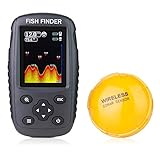
If you fish from shore, from ice or from a rented boat that changes every week, a mounted unit is the wrong tool. The Venterior is built around that reality. A rechargeable wireless sonar sensor casts out and transmits back to a handheld colour display, with Venterior citing a maximum separation of 262 ft between sensor and unit.
What it reports goes further than the other portable pick here. Water depth, water temperature, fish size grouped as small, medium or big, fish depth and bottom contour. Temperature is the one that earns it a place, because none of the other portable options publishes it and temperature drives where fish sit through the season. Two selectable screen backgrounds, black and white, are offered for daylight and night readability. There's also a Simulation Mode for learning the interface off the water.
The two-year warranty is the surprise. That's longer than the Striker 4, the Helix 5 G3 and the Eagle 4X all publish, on the second-cheapest pick in the group. At 0.94 lb and a 2.75-inch cube for the sensor, it's easy to carry.
The trade-offs are the obvious ones. No satellite positioning, no screen diagonal stated, and a wireless link that has to survive wind and distance.
Pros:
- Reports water temperature, unique among the portables here
- Two-year warranty, longer than three mounted picks
- Claimed 262 ft wireless range from the sensor
- 0.94 lb total, easy to carry all day
- Simulation Mode for learning the display
Cons:
- No GPS or waypoint storage
- Screen size not stated on the listing
- Wireless link limits you to a 262 ft radius
- Fish size reported only as small, medium or big
- Sensor needs recharging between sessions
7. LUCKY Kayak Portable Fish Depth Finder — Best budget pick
The cheapest of the seven and a genuinely one-handed unit at 4.8 x 2.68 x 1.18 in, with a fish alarm and a neck strap in the box.

Best for: a first look at depth and weeds from shore Skip it if: you want temperature readings or a warranty on paper
This is the entry point to the category, and it does one job. Toss the transducer, read approximate fish location and water depth on the LCD. LUCKY says the display also distinguishes short and tall weeds and separates sand from rocks on the bottom, which is more bottom-composition detail than the price position suggests.
The handheld body measures 4.8 x 2.68 x 1.18 in, and the listing describes it as sized for a single hand, with a neck strap included so you can wear it while your hands are busy. A fish and fish-schools alarm sounds when targets pass the sensor, useful when you're watching a rod tip rather than a screen. LUCKY positions it for boat fishing, ice fishing and shore fishing in fresh or salt water.
Where it falls short is documentation. No weight, no colour and no screen size appear in the specifications, and it's the only pick in this set with no published warranty at all. The Venterior, at the next price step up, publishes two years and adds water temperature. That's a small gap in cost for a real gap in capability, and it's why this sits seventh rather than higher.
Pros:
- Cheapest pick in this comparison
- One-handed 4.8 x 2.68 x 1.18 in body with neck strap
- Reports weeds and separates sand from rocks
- Fish and fish-schools alarm built in
- Works from shore, boat or ice
Cons:
- No published warranty, the only pick here without one
- No water temperature reading
- Weight and screen size not stated
- No GPS or waypoint function
- Venterior adds temperature and a warranty for little more
Fixed-mount or castable: which fish finder fits your boat?
This is the fork in the road, and it comes before screen size, brand or sonar type.
Go fixed-mount if you own the boat or fish the same one every time. The Striker 4 at 5.9 x 3.6 x 1.6 in, the Eagle 4X at 3.84 x 7 x 4 in, the Vivid 7cv at 7 x 3.4 x 6.1 in and the XPLORE 9 at 6.26 x 11.7 x 3.3 in all need a bracket, a power feed and a transducer run to the hull or transom. Measure your console before you order. The Helix 5 G3's published 9.63 x 15.8 x 4.75 in box is the largest here.
Go castable if any of these apply:
- You fish from the bank as often as from a boat
- You fish through ice and want to check holes fast
- You rent or borrow boats
- You want something that lives in a tackle bag
The LUCKY and the Venterior cover that ground. Neither offers satellite positioning, so both trade memory for mobility.
The kayak case is the awkward one. The Eagle 4X's portrait screen and the Striker 4's 8 oz weight both work on a kayak. The Vivid 7cv at 4.4 lb does not.
What the listings don't tell you
Some gaps in the published data are worth knowing about before you commit.
Beam angle only appears once. Lowrance states a 44-degree beam for its 200 kHz Bullet Skimmer. Nobody else publishes a cone angle, so you can't compare coverage width across brands from these listings alone.
Maximum depth appears once too, on the Striker 4: 1,600 feet freshwater, 750 feet saltwater. The Humminbirds cite 200-foot imaging ranges, which is a different measurement from maximum sounding depth. Don't treat them as equivalent.
Battery arrangements are mostly unstated. The Venterior is described as rechargeable. The LUCKY listing says nothing about power source. Mounted units assume boat power, but the listings don't specify draw.
Transducer mounting style is also thin. Every unit includes a sensor, but only the Lowrance names its type as a Skimmer. If your hull needs a specific mount, check the product page before ordering.
Release years vary widely. The Striker 4 dates to 2015, the Vivid 7cv to 2020, and both Humminbirds are listed as 2026 models.
The verdict
The Garmin Striker 4 is the winner of this group, and the reason is the capability-to-footprint ratio. An 8 oz head unit measuring 5.9 x 3.6 x 1.6 in that runs CHIRP sonar, ClearVü scanning and a working waypoint map is the only pick here that does all three without a premium price or a large console. Freshwater depth is stated at 1,600 feet. IPX7 is on the listing. For most people asking about the best fish finders, that's the whole answer.
Two conditions flip it. First, if you fish water where finding structure off to the sides matters, the Humminbird XPLORE 9 is the only pick claiming MEGA Side Imaging+ to 200 feet per side, on a 9-inch 1280 x 720 screen with a three-year warranty on registration. Nothing else here comes close on that axis. Second, if you don't have a boat to mount anything on, the Venterior VT-FF005 casts a wireless sensor to a claimed 262 ft and reports water temperature, which the cheaper LUCKY does not.
The Striker Vivid 7cv's exact advantage over the Striker 4 is screen and colour: 7 inches with selectable sonar palettes and a two-year warranty instead of one. If console space and budget both allow, that's a real upgrade on the same sonar platform.
FAQ
Are expensive fish finders worth the extra money?
Expensive fish finders are worth it when you can name the feature you're buying. In this set, the top tier buys measurable things: a 9-inch 1280 x 720 screen, MEGA Side Imaging+ claimed to 200 feet per side, preloaded cartography for 10,000-plus lakes, and a three-year warranty. If you fish a single small pond, none of that changes your catch and the Striker 4 does the job.
Is a fish finder worth it on a kayak?
A fish finder is worth it on a kayak, but weight and screen orientation decide which one. The Striker 4 weighs 8 oz, which is the lightest mounted unit here by a wide margin. The Lowrance Eagle 4X uses a 4-inch portrait IPS screen that suits narrow rails. The 4.4 lb Striker Vivid 7cv is too much boat electronics for most paddle craft.
Do all these fish finders include GPS?
Not all of these fish finders include GPS. Four of the seven publish satellite positioning: the Garmin Striker 4, the Striker Vivid 7cv, the Humminbird Helix 5 G3 and the XPLORE 9. The Lowrance Eagle 4X, the Venterior VT-FF005 and the LUCKY FFC1108 list none. Without it you can see structure but you cannot mark a waypoint and return to it later.
Garmin Striker 4 or Lowrance Eagle 4X for a first fish finder?
Garmin Striker 4 or Lowrance Eagle 4X comes down to one line in the specifications. The Eagle 4X is cheaper, has a slightly larger 4-inch portrait screen and auto-tunes its own sonar settings. The Striker 4 publishes a waypoint map and GPS, which the Eagle does not. If you want to save spots, pay the difference. If you only want to read depth, don't.
What mistake do first-time fish finder buyers make?
The mistake first-time buyers make is choosing on screen diagonal alone. In this comparison, the 4-inch Eagle 4X has a bigger screen than the 3.5-inch Striker 4 but no positioning at all. Check whether GPS and mapping are published, then check the housing dimensions against your console. A 9.63 x 15.8 x 4.75 in box does not fit every boat.
Start by deciding whether you're mounting anything at all. That single answer eliminates four or five of these seven immediately, and it takes ten seconds of looking at your boat. If you are mounting, the Garmin Striker 4 remains the sensible default not because it's the most capable unit here, but because it's the one whose 8 oz, 5.9-inch body will physically fit wherever you put it, while still saving the waypoints that turn a lucky day into a repeatable one. Everything above it in price adds screen and scanning. Nothing above it adds a better first fish finder.